An Auspicious Weekend In October – Offering Of Robe Material

by Bhikkhuni Seri

Upulmali Govinnage offered the Robe Material to the Bhikkhunis at Patacara Bhikkhuni Hermitage on Sunday morning, 28th October 2012. Photo by Manora.

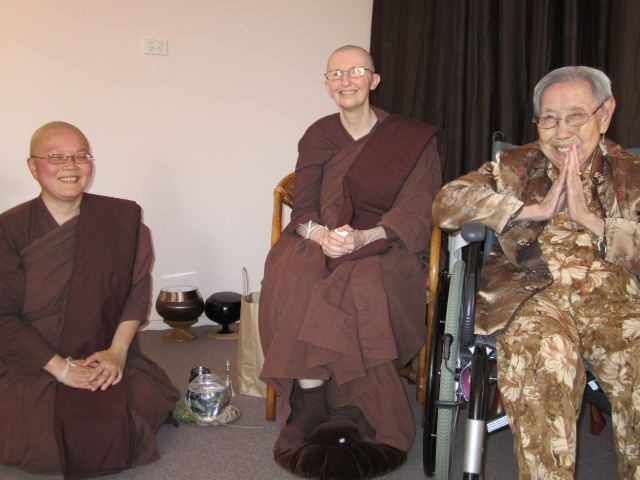
On Sunday, 28th October 2012, we had a simple Offering  Of Robe Material Ceremony in the presence of 25 lay supporters, to mark the End of the Rains (Vassa) 2012 at Patacara Bhiikhuni Hermitage. Ayya Vayama’s cousin, Karina, and Aunty Shirley, Karina’s mother, arrived before 10.00am to meet Ayya Vayama and wish her Happy Birthday! Karina had come with her husband to visit Ayya Vayama earlier in May. Karina  returned to Perth from Sydney  especially to celebrate Ayya Vayama’s 60th birthday and brought her mother, Aunty Shirley with her. Ayya Vayama and all of us at Patacara Bhikkhuni Hermitage were delighted to have the presence of Karina and Aunty Shirley for the Auspicious Occasion and the 60th Birthday Celebration.

Ayya Vayama Bhikkhuni, Ayya Seri Bhikkhuni, Karina and Aunty Shirley inside the Sala of Patacara Bhikkhuni Hermitage on Sunday morning, 28th October 2012. Photo by Ming.

Ayya Vayama Bhikkhuni, Ayya Seri Bhikkhuni and Ayya Seri’s grandma, Ah Ying, sang ‘Happy Birthday’ in Cantonese inside Sala of Patacara Bhikkhuni Hermitage on Sunday morning, 28th October 2012. Photo by Ming.

Before the official start of  Offering Of Robe Material Ceremony, Ayya Seri’s grandma, Ah Ying, sang a traditional ‘Happy Birthday’ in Cantonese to wish Ayya Vayama good health and happiness. This was then followed by birthday good wishes in Sinhala led by Ananda, wishing Ayya Vayama the attainment of Nibbana in this very life. We had to delay the special birthday wishes in English until the Birthday Celebration in the afternoon! 

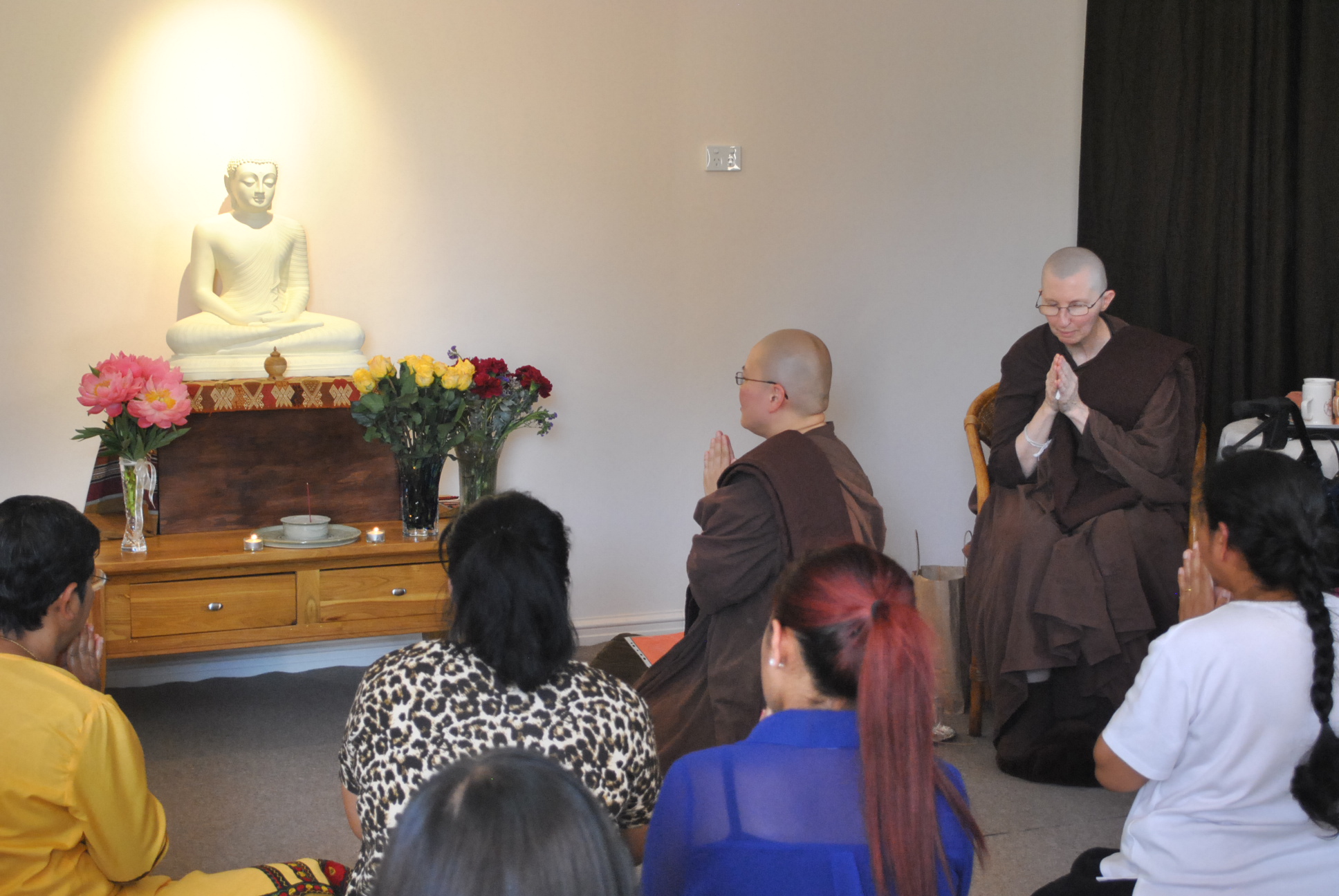
Paying Homage to Buddha, Dhamma and Sangha inside the Sala of Patacara Bhikkhuni Hermitage on Sunday morning, 28th October 2012. Photo by Manora.

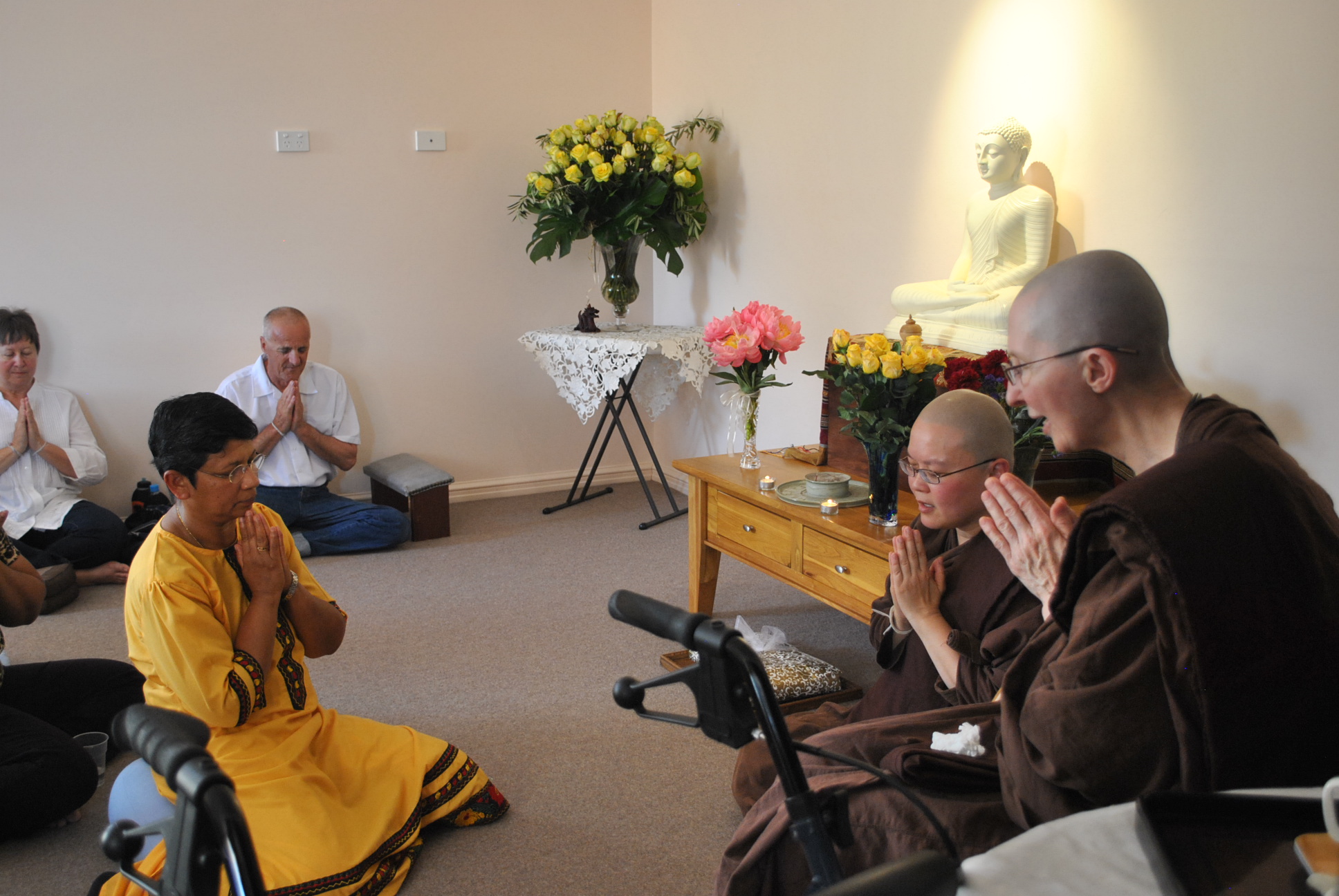
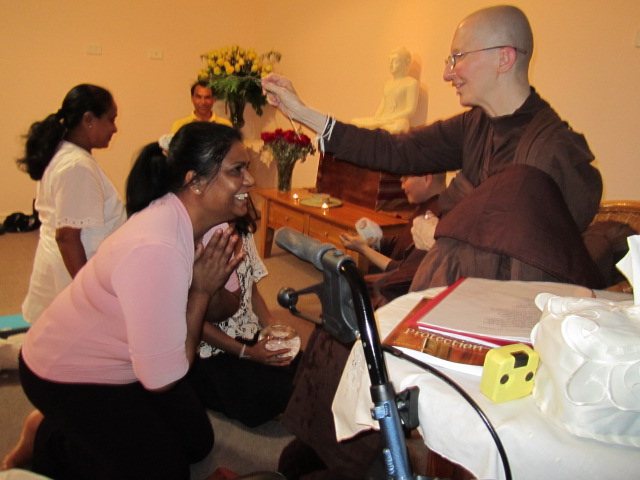
We started the Offering of Robe Material Ceremony by paying homage to the Buddha, Dhamma and Sangha, followed by offering of Refuges and Five Precepts by Ayya Seri. Upulmali Govinnage offered the robe material to the Bhikkhunis of Patacara Bhikkhuni Hermitage this year. A special blessing was offered to Upulmali Govinnage and those who were present for the offering of robe material. We concluded the Offering of Robe Material Ceremony with a blessing by the Bhikkhunis for the offering of dana.

Blessing for the Offering of Robe Material to the Bhikkhunis at Patacara Bhikkhuni Hermitage on Sunday morning, 28th October 2012. Photo by Manora

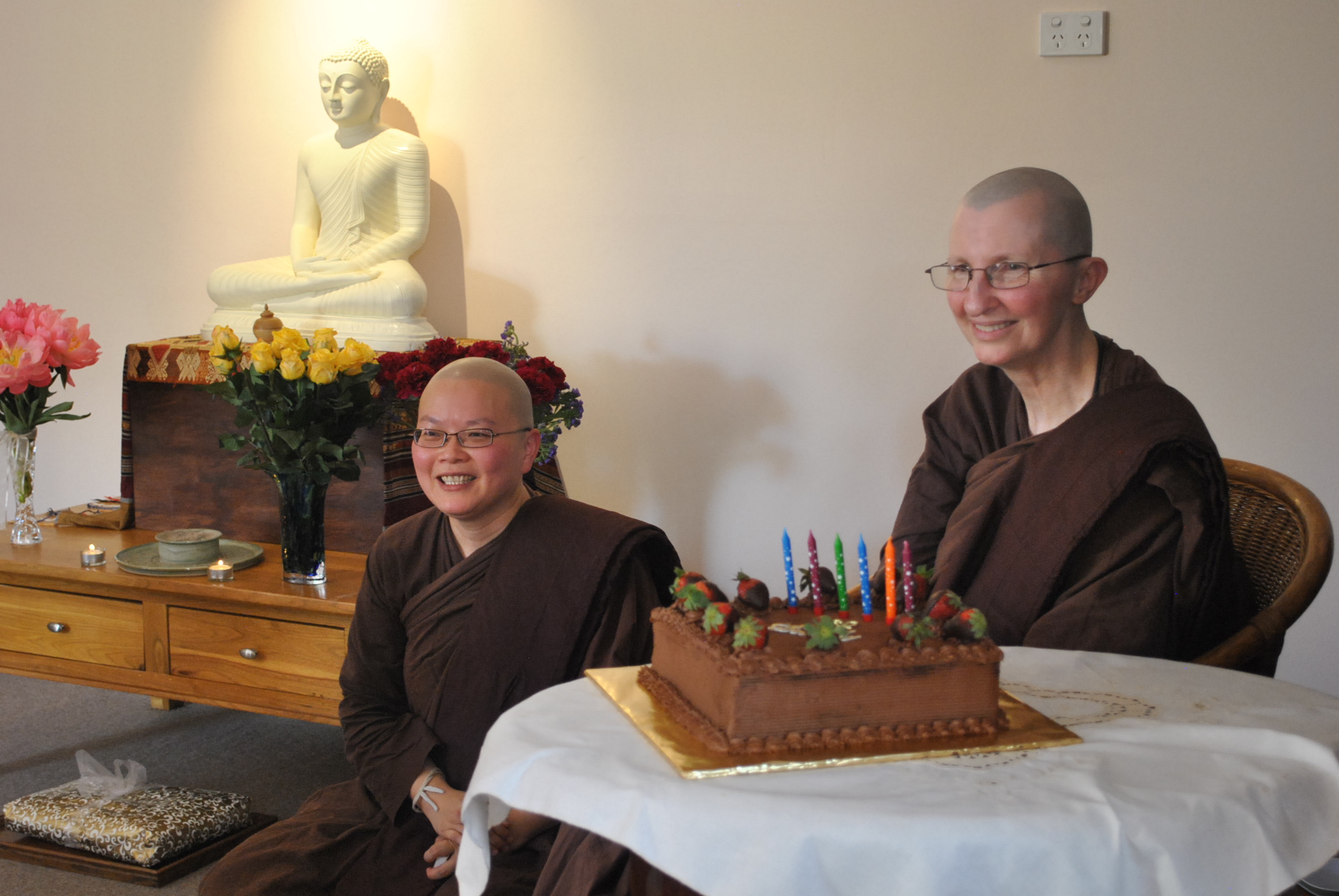
Lighting the candles on Ayya Vayama Bhikkhuni’s birthday cake on Sunday morning, 28th October 2012. Photo by Ming.

Before the dana, a delicious chocolate birthday cake was offered for Ayya Vayama’s birthday. The Bhikkhunis had the opportunity to sample the  birthday cake during the dana before noon!

The delicious chocolate birthday cake offered for Ayya Vayama Bhikkhuni’s 60th birthday on Sunday morning, 28th October 2012. Photo by Manora.

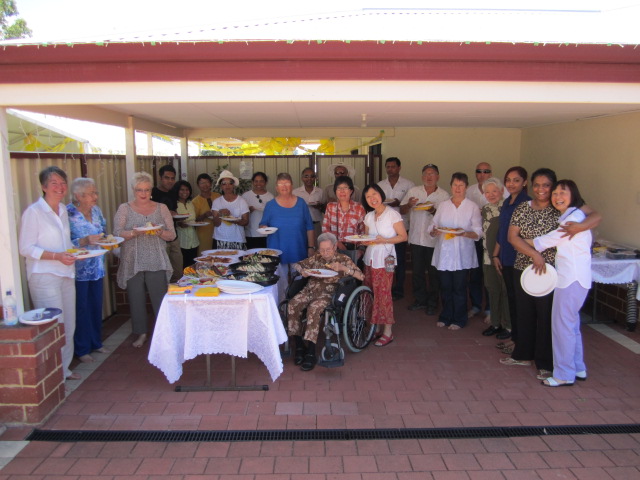
Dana on Sunday morning, 28th October 2012 at Patacara Bhikkhuni Hermitage. Photo by Peace.

Posted in Events, Year 2012 | Tagged , | Leave a comment

An Auspicious Weekend In October – Paritta Chanting Night

by Bhikkhuni Seri

Paritta chanting and meditation on Saturday night, 27th October 2012 for Ayya Vayama Bikkhuni’s 60th Birthday, at Patacara Bhikkhuni Hermitage. Photo by Havindra.

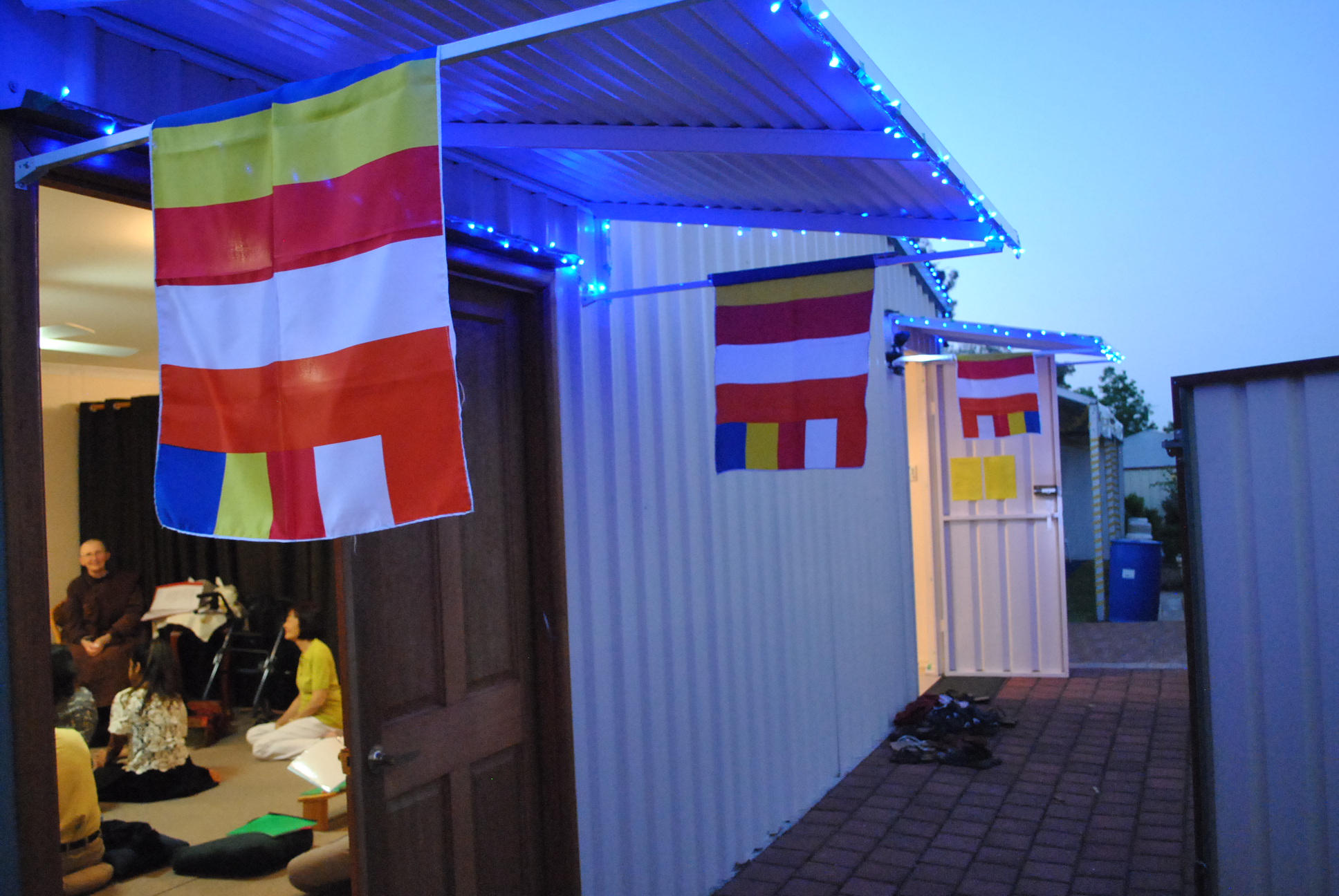
The Paritta chanting and meditation  started at 7.00pm  on Saturday, 27th October, on the eve of Ayya Vayama Bhikkhuni’s 60th Birthday. The beautiful lights were twinkling and glowing throughout the evening at Patacara Bhikkhuni Hermitage.

Paritta chanting at Patacara Bhikkhuni Hermitage on Saturday evening, 27th October 2012. Photo by Ming

We started the evening with paying homage to the Buddha, Dhamma and Sangha and the taking of Refuges and Five Precepts. We passed the Paritta string around to everyone in the sala of Patacara Bhikkhuni Hermitage. All of us sitting in the sala were connected by the Paritta string of good will and lovingkindness. We chanted the Three Suttas – The Maha Mangala Sutta, The Ratana Sutta and The Metta Sutta.

Offering of blessing by Ayya Vayama Bhikkhuni after Paritta chanting at Patacara Bhikkhuni Hermitage on Saturday, 27th October 2012. Photo by Ming.

After the Paritta chanting, we sat quietly and meditated together. At the  end of the meditation, we chanted Bojjhanga Paritta – The Factors of Enlightenment Protection, for seven times for Ayya Vayama Bhikkhuni. Traditionally, Bojjhanga Paritta is associated with good health. The following is a translation of Bojjhanga Paritta from ‘The Book of Protection’ by Venerable Piyadassi Thera:

Seven are the factors of Enlightenment well expounded by the all-seeing Sage (the Buddha), cultivated and fully developed by him.

They are: Mindfulness, Investigation of the Dhamma, Persevering Effort, Rapture, Calm, Concentration, Equanimity. They conduce to perfect understanding; to full realization and to Nibbana.

By the power of the truth of these words may you ever be well.

On one occasion the Buddha, the Protector, seeing that the Theras Moggallana and Kassapa were ill and in distress, declared the seven Factors of Enlightenment hearing which they rejoiced and recovered from the illness.

By the power of the truth of these words may you ever be well.

Once the King of the Dhamma(the Buddha) himself was afflicted by an illness. Cunda Thera with great compassion declared the Factors of Enlightenment. Instantly the Buddha recovered from that illness.

By the power of the truth of these words may you ever be well.

Thus ceased the afflictions of the three great sages, who having removed the defilements by the Path, attained accomnplishment in the nature(essence) of the Dhamma.

By the power of the truth of these words may you ever be well.

Offering of blessing by Ayya Vayama Bhikkhuni after Paritta chanting at Patacara Bhikkhuni Hermitage on Saturday, 27th October 2012. Photo by Ming.

We finished the evening with the sharing of merits. We especially dedicated the merits of Paritta chanting and the practice of meditation to our teacher, Ayya Vayama Bhikkhuni for her 60th Birthday. May Ayya Vayama be well and at peace, may she attain Nibbana in this very life!

After the Paritta chanting, everyone was asked, before their departure from the Hermitage that night, to blow up a balloon for the birthday celebration the following day. 

The ballon blowers after the Paritta chanting at Patacara Bhikkhuni Hermitage on Saturday night, 27th October 2012. Photo by Ming.

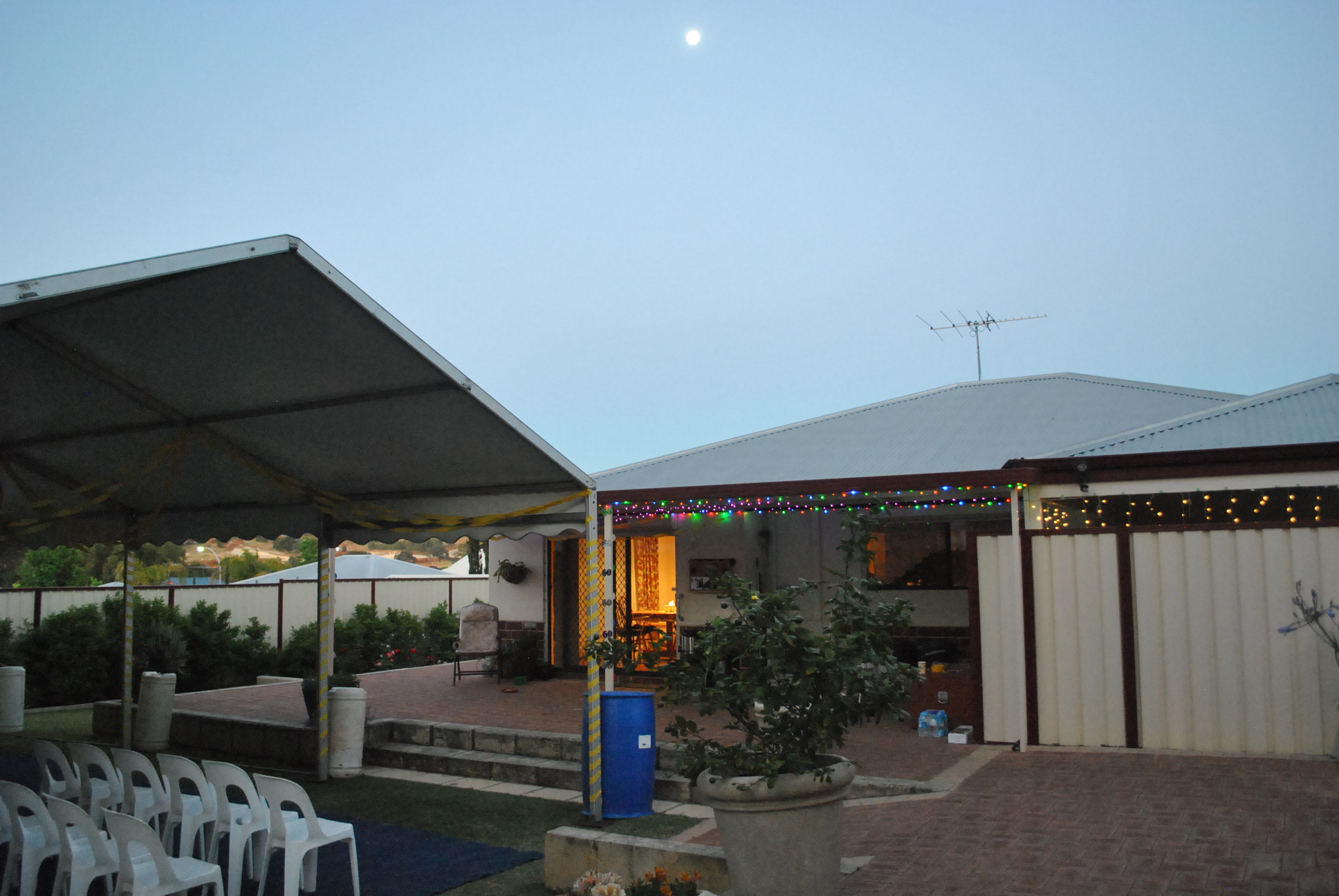
The lights were switched off after the last person departed. Silence once again fell upon the Hermitage, with the moon glowing softly in the darkness of the sky.  The sound of the Paritta chanting lingered around, filling the Hermitage with good will, peace and lovingkindness.

Patacara Bhikkhuni Hermitage on Saturday evening, 27th October 2012. Photo by Havindra.

Posted in Events, Year 2012 | Tagged | Leave a comment

An Auspicious Weekend In October – The Setting Up

by Bhikkhuni Seri

In our journey, we often only focus on the goal, the destination, and we miss out on the joy and laughter along the way. Sometimes we tend to waste our time and throw our life away by rushing around chasing the Enlightenment moment. We have forgotten to be here and to be in this  precious moment in front of us, because this is all we have, NOW.

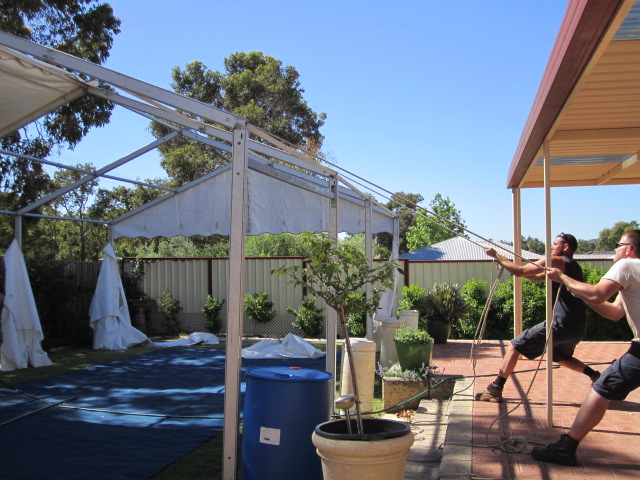
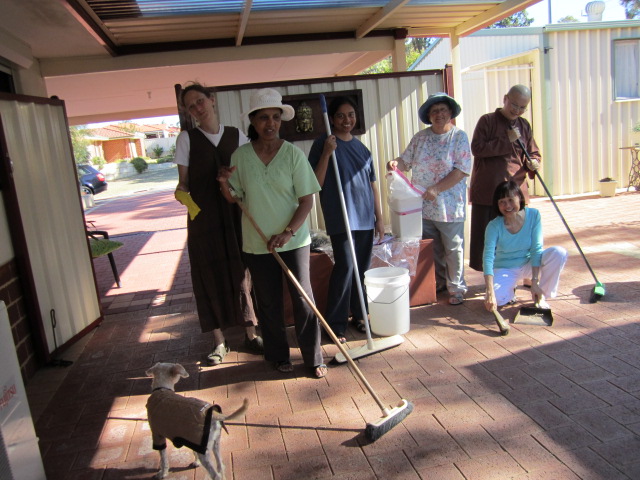
The Operation Taskforce in action at Patacara Bhikkhuni Hermitage, with assistant superintendent, Billy, the poodle, on Friday, 26th October.


The ‘Auspicious Weekend In October’ started on Friday, 26th October. The first Operation Taskforce arrived after dana at around 1.30pm, ahead of the delivery of  the marquee and the Portaloo. The first Operation Taskforce consisted of the set up squad and the dust busters. The Operation Taskforce rolled up their sleeves and tackled the work; vaccuming the sala, cleaning the shrine and the Buddha statue, sweeping, dusting the chairs and rearranging the furniture. Our assistant superintendent, Billy, the poodle, wandered around to make sure we all attended to our jobs.

The setting up of marquee at Patacara Bhikkhuni Hermitage on 26th October.

The marquee arrived after 2.30pm. Then, suddenly, the Hermitage was filled with poles, chairs and tarpaulins and more Opeartion Taskforce members. It seemed busy but there was laughter and kindness. We admired the skills of the people setting up the marquee with such precision and efficiency. Before long, everything was in its place, and it looked like we were having a big weekend of celebration!

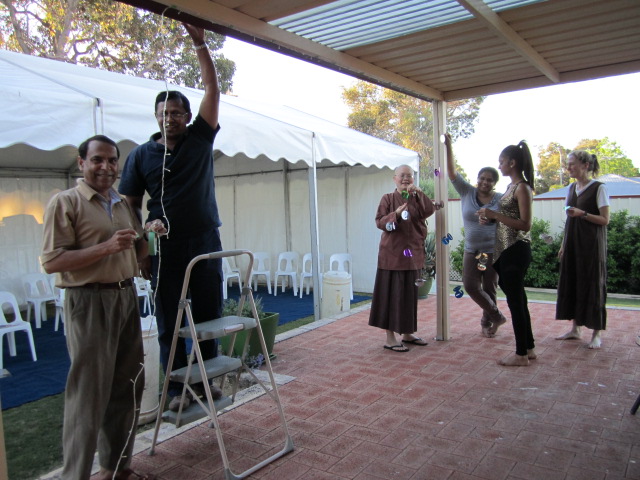
The lighting engineers and the decoration specialists at Patacara Bhikkhuni Hermitage on Friday, 26th October.

The decoration specialists inside the marquee on 26th October at Patacara Bhikkhuni Hermitage.

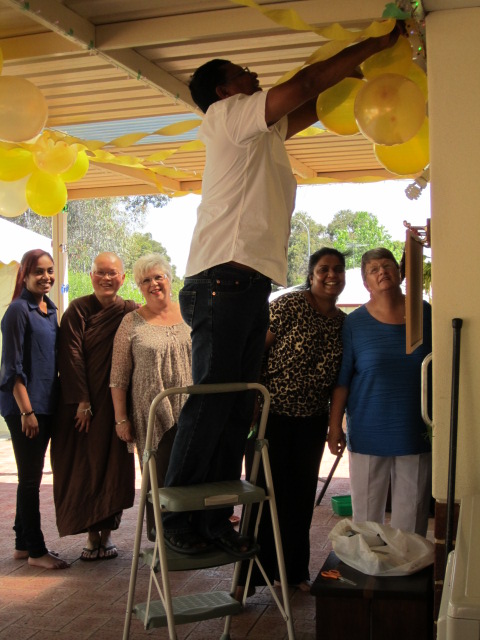
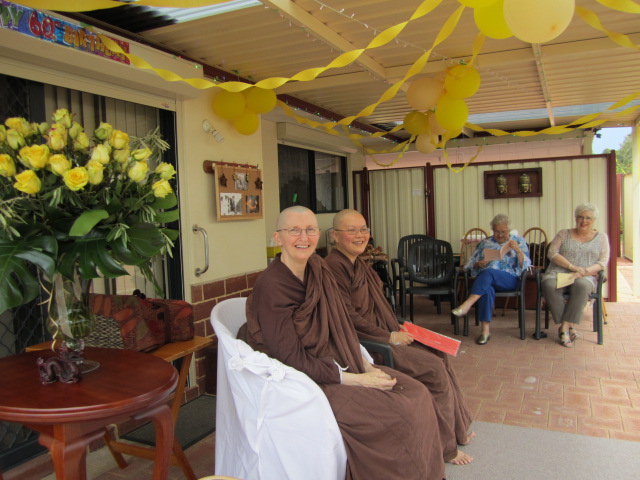
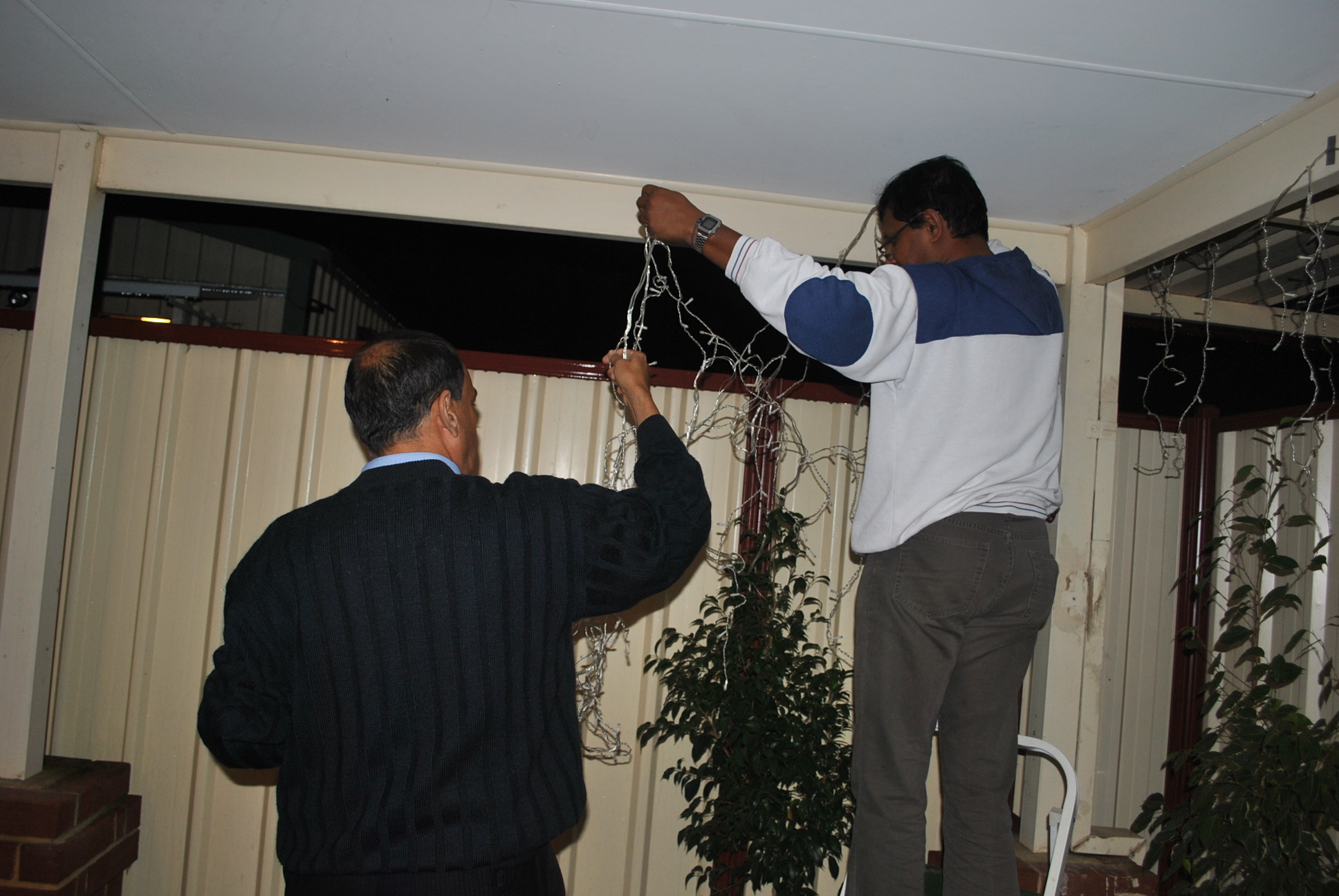
The second Operation Taskforce arrived at around 5pm to take over the work. This time, the lighting engineers and decoration specialists turned up with their gear. The decoration specialists consisted of a group of women with many creative ideas and yet we managed to work together harmoniously and cheerfully and expressed our opinions clearly. The result was a beautiful and bright decoration of streamers and balloons that filled the Hermitage with an atmosphere of celebration.  At the other side of the Hermitage, you could hear the soft murmurs of Sinhala seeping through the evening while the beautiful lights were hung.

The Superintendent, Ayya Vayama relaxed and had a cup of tea inside during the setting up on Friday, 26th October 2012, at Patacara Bhikkhuni Hermitage.

The last of the setting up Operation Taskforce signed off at 9.00pm. We were all tired. But our hearts were full of joy, happiness and gratitude. We offered our effort, time and energy to celebrate the 60th birthday of our teacher, AYYA VAYAMA  BHIKKHUNI.  We relished the opportunity to show our heartfelt gratitude and respect.

Display of Ayya Vayama’s photos from age 10 to her time in Sri Lanka and her most recent photos at Patacara Bhikkhuni Hermitage during ‘An Auspicious Weekend in October’.

(All the photos provided by Ming)


Posted in Events, Year 2012 | Leave a comment

An Auspicious Weekend In October – Foreword

by Bhikkhuni Seri

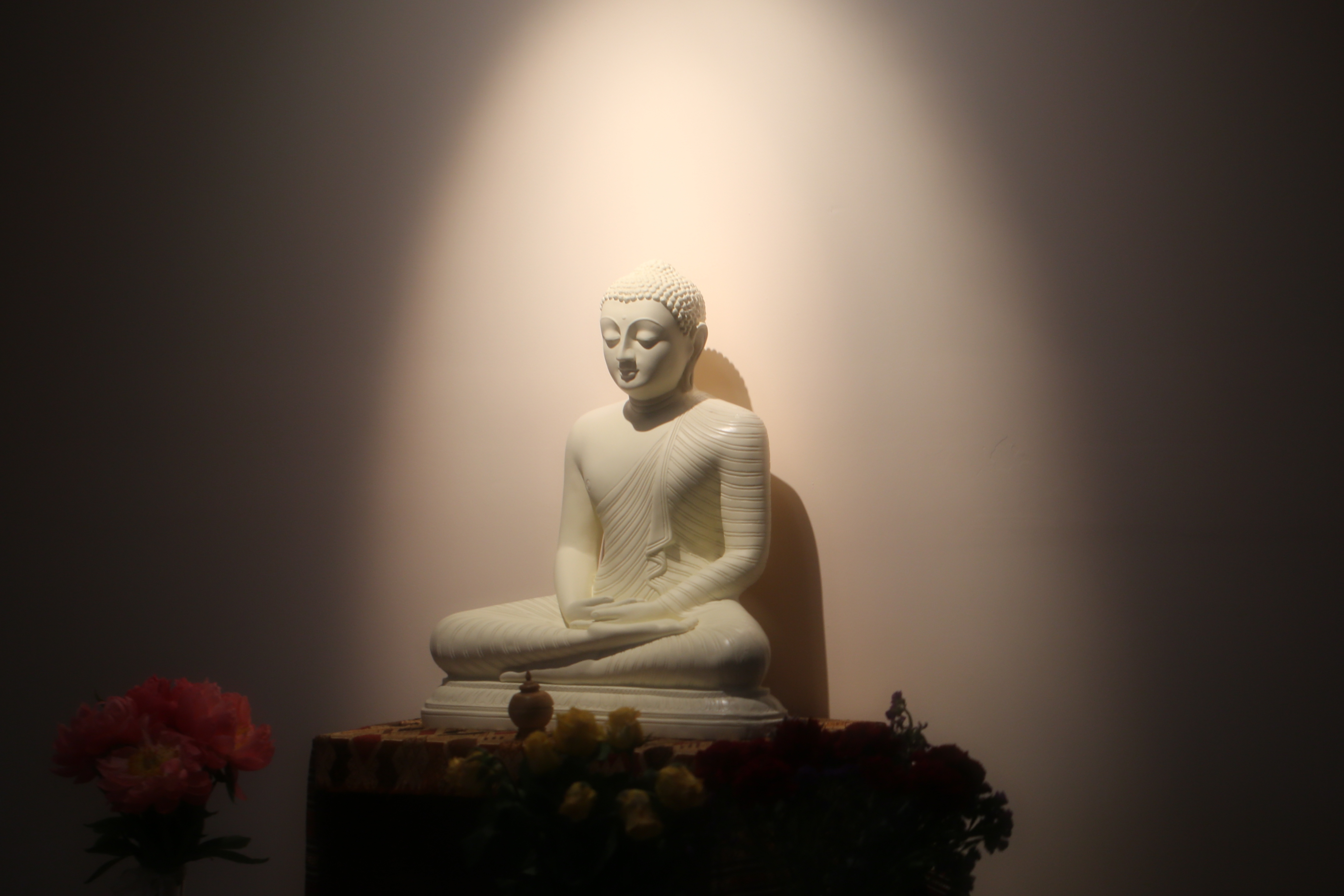
The peaceful Buddha on the ‘Auspicious Weekend In October’ in 2012 at Patacara Bhikkhuni Hermitage. Photo by Zor.

All of us at Patacara Bhikkhuni Hermitage celebrated Ayya Vayama Bhikkhuni’s 60th birthday with ‘An Auspicious Weekend’ of Paritta Chanting on Saturday night, 27th October, Offering of Robe Material Ceremony and the Metta Birthday Celebrations on Sunday, 28th October 2012.

Ayya Vayama Bhikkhuni on her 60th birthday celebration at Patacara Bhikkhuni Hermitage. Photo by Zor.


The setting up squad and Billy, the assistant superintendent on Friday, 26th October. Photo by Ming.

We appreciated the help from all our volunteers, from the members of Patacara Bhikkhuni Hermitage Incorporated; to our team of parking inspectors, decoration specialists, lighting engineers, catering masters, photographers and the garbage manager. Without every single one of your efforts, there would be no celebrations.


The parking inspectors at work on Sunday, 28th October 2012. Photo by Zor.

Catering masters prepared the drink table on Sunday, 28th October 2012.  Photo by Ming.

We would like to offer our heartfelt thank you to all of you who participated in the ‘An auspicious weekend in October’. Your attendance made the celebrations a more complete event. We especially would like to extend our appreciation to Ayya Vayama’s cousin, Karina, and Karina’s mother and Ayya Vayama’s Aunty Shirley who flew from Sydney for the birthday celebration. Your presence delighted Ayya Vayama and all of us at Patacara Bhikkhuni Hermitage. We also would like to mention our special guest, Dr Ping Wang, Ayya Vayama’s Chinese medicine doctor who delayed her holiday to attend the birthday celebration. 

The final preparation on Sunday morning, 28th October 2012 at Patacara Bhikkhuni Hermitage. Photo by Ming.

Most of all, with our gratitude and respect to AYYA VAYAMA BHIKKHUNI for being here, for giving us the opportunity to come together to celebrate your SIXTIETH BIRTHDAY. May you have well being and peace, may you attain your goal, Nibbana in this very life.

HAPPY SIXTIETH BITHDAY, AYYA VAYAMA BHIKKHUNI!

Ayya Vayama Bhikkhuni, Ayya Seri Bhikkhuni, Aunty Shirley and cousin Karina at the 60th Birthday Celebration at Patacara Bhikkhuni Hermitage on 28th October 2012. Photo by Ming.

Posted in Events, Year 2012 | Tagged | Leave a comment

Spiritual Warriors by Bhikkhuni Seri

I would like to share with you the transcription of a Dhamma reflections that I offered at Dhammaloka Buddhist Centre,  The Buddhist Society of Western Australia, on 19th October 2012.

SPIRITUAL WARRIORS

Namo Tassa Bhagavato Arahato Sammasambuddhassa
Buddham Dhammam Sangham Namasami.

Good evening everyone. I am Bhikkhuni Seri, a resident nun from Patacara Bhikkhuni Hermitage. My teacher is Ajahn Vayama. I entered the monastic training as anagarikaa in 2002, and ordained as a Ten Precept nun in July 2004. I received my full ordaination as a bhikkhuni in October 2009.

Tonight, I would like to explore the concept of Spiritual Warrior. When we hear the word Warrior, we think of a fighter, a brave combatant, a person experienced or distinguished in fighting in an armed force, tribe etc.

The concept of Spiritual Warrior resonates with me. To me, Spiritual Warriors are trained and distinguished fighters on the spiritual path. They are not fighting on the killing field to harm. I associate spiritual warriors with qualities such as courage, determination, harmlessness, patience, truthfulness, integrity, renunciation, energy, lovingkindness, compassion and peace. Spiritual Warriors practise for liberation and freedom.

 As a Buddhist Bhikkhuni, a nun, I consider the Buddha as an ideal role model of a distinguished spiritual warrior who attained liberation and freedom. The Buddha also taught and trained His disciples, leading them to liberation and freedom.

The Buddha was born into the Sakyan clan, the Khattiya, the warrior caste in India, more than 2500 years ago. The Buddha was not just from the warrior caste, he was a prince, who had power and good fortune. But the Buddha renounced his fortune to seek wisdom, liberation and freedom. 

The Pabbajjha Sutta- The Going Forth Sutta in the Sutta Nipata, describes the encounter between the Buddha-to-be, the ascetic Gautama, and King Bimbisara, the King of Magadha in India. King Bimbisara saw the Buddha-to-be going for his alms and was impressed by his behaviour and conduct. King Bimbisara found out where the Buddha-to-be lived and went to see him.

King Bimbisara said to the Buddha-to-be:
‘You have the good looks of a man
Of high-born warrior-noble stock,
One fit to grace a first-rate army,
To lead the troops of elephants.
I offer you a fortune: take it.
Your birth I ask you also: tell it.’

The Buddha replied:
“’There is a prosperous country, sire,
And vigorous, right up against
 The foothills of Himalaya,
Inhabited by Kosalans
Whose race is named after the Sun,
Whose lineage is Sakyan.
But I have not gone forth to seek sense pleasures.
I have gone out to strive, seeing danger in them,
And seeing safe refuge from them in renouncing.
That is my heart’s desire.’

The Buddha was clear and resolute in his quest for liberation.  King Bimbisara tempted him with great wealth and fortune and the power of being the head of his armed forces. The Buddha was Immovable. He found refuge in renunciation, and determined to practise for liberation. He was a leader on the Spiritual Warrior path.

I love the Jataka story describing the battle between the Buddha-to-be, the ascetic Gautama, before he attained nibbana, and Mara-the tempter, the obstructor.  Mara came with his large force to make a great effort and displayed much power against the Buddha-to-be, who was meditating and contemplating quietly by himself. The Buddha-to-be had no one there to protect him. The only thing he could do was to use his practise, to shield himself and as weapon of attack. 

Mara asked the Buddha-to-be to get up from his seat. The Buddha-to-be said to Mara: “I have the right to this seat. I have been practising the Ten Paramis for many life times”. For your information, the Ten Paramis are: generosity, morality, renounciation, wisdom, energy, patience, truthfulness, resolution, lovingkindness and equanimity. The Buddha continued, “Even though I have no living being here with me, let this great and solid earth be my witness.” Then the Buddha-to-be, pulling his right hand from underneath the fold of his robe, stretched it out towards the earth saying, “Are you my witness?” The great earth resounded with a hundred, a thousand or a hundred thousand echoes as though to overwhelm the forces of Mara, and saying , “I was your witness.”

All of us are sitting here, inspired by the Buddha, aspiring to be Spiritual Warriors like the Buddha, aspiring to practise and train on the Spiritual Warrior path for freedom and liberation.

But, how do we train and practise as spiritual warriors? As a Buddhist, the spiritual warrior’s path is the Eightfold Path:
1.Right Understanding ( Samma-ditthi )

2. Right Thought ( Samma-sankappa )
3.Right speech ( Samma-vaca )

4.Right bodily action ( Samma-kammanta )
5. Right livelihood ( Samma-ajiva )
6.Right effort ( Samma-vayama )

7.Right mindfulness ( Samma-sati )                  
8. Right Concentration ( Samma-samadhi )

Tonight, the fact that we are here, seizing the opportunity to meditate, we are already planting the seeds, we are taking this step to be Spiritual Warriors. We are indeed following in the footsteps of the Buddha.

Practice as Spiritual Warriors does not mean a spectacular display of fireworks or thunder and cheers. The practice of Spiritual Warriors is like strands that we weave into the fabric of day-to-day living, whole heartedly and patiently with love and care. The practice is like collecting water into the bucket of liberation, drop by drop and moment by moment.

When we arrived and entered into this hall, we bowed down to the Buddha. We’ve already entered into the Spiritual Warriors’ path. Do not take this act of bowing lightly. Bowing shows and trains our humility. Bowing shows our respect and our gratitude to the Buddha, the teacher who showed us the path. We bow three times, first to the Buddha, then to the Dhamma, the teaching of the Buddha and then to the Sangha, the Community of those Enlightened by practising the path. Traditionally, when we bow, when we show our respect and gratitude, we bow whole heartedly, with our head touching the ground, both our hands and elbows are also touching the ground.

I remember hearing a story from my teacher. She told the story of a nun who could not see the point of bowing and used bowing as yoga exercise. The nun gradually saw and worked with the resistance in her own heart. Eventually, with greater understanding and connection with the Buddha, Dhamma and Sangha, she appreciated the beautiful  gesture of bowing.

When we come to a Buddhist centre, we are looking for something that can lead us to peace, to freedom, to liberation. We aspire to be a spiritual warrior. We need to use the opportunity, any opportunity, to be awake, to look at the resistance and openness in our heart. Bowing seems to be a small gesture. When we bow, we are fully aware and mindful where we put our hands, our head and the movement of our body. We can use a small action and gesture to practise and to learn about ourselves, our mind and our heart.

I have an experience to share with you. This will show you that I was not a born nun, that I had difficulties like some of you with bowing and sitting cross legged on the floor.

I went to my first weekend retreat in 1998/1999 in Safety Bay with Ajahn Vayama. I was not used to sitting on the floor for a long time. So I stretched my legs and, not knowingly pointed my feet to Ajahn Vayama and the shrine, to relieve my pains and aches. Ajahn Vayama said to me: “The lady in red t-shirt, please do not point your feet to the teacher and the shrine out of respect to the Buddha, Dhamma and Sangha!”

I was really angry with Ajahn Vayama for that comment. In my mind, I was saying, “Who is she to ask me not to point my feet! Doesn’t she know that my legs are sore!” Even though I was angry, I continued to stay on the retreat because I had taken time off work and had paid for the retreat! But, during the retreat, my mind was full of resistance.  In the retreat, Ajahn Vayama conducted a walking meditation in a circle, and all of us were asked to walk according to the beats of her wooden fish, to practise concentration with a bit of fun! Because my mind was full of resistance, and being rebellious, I purposely walked slowly when Ajahn hit the wooden fish fast. And I purposely walked faster when Ajahn’s beats were slow. This created lots of annoyance among the other retreatants. One of the retreatants who was a music teacher told me later that she thought this lady had some serious problem!  Even her year 1 students in her class can walk according to the beat! She did not realise that I was doing it purposely because I was rebellious and full of resistance towards the teacher!

I must admit at that time, I did not have the mindfulness to be aware of my resistance. I just acted out my unskilfulness! This seemingly harmless act of rebellion affected others on the retreat and caused them irritation and agitation! This particular incident must have left an impression in my mind that sparked the urge to walk the Spiritual Warrior path.

 As Spiritual Warriors we need to be aware and honest with our feelings, actions and reactions in our life. We need to be awake and alert to our situation, to be fully present with whatever is in front of us and not to run away from life. We can learn and practise with whatever situation we are in for greater understanding of ourselves, for peace and ease, for liberation.

I would like to share with you one of the powerful moments that I experienced recently. I was at Bendat Cancer Centre in Subiaco. I was standing outside the toilet waiting for someone. Then, out the corner of my eye, I saw a lady with her hand on a drip, who was weak and frail walking pass. I caught myself instinctively turning my head away. I turned my head away because I could not bear the pain and suffering that I was looking at. Most of all, I recognised this fear, fear of suffering in me. The fear that it could be me.  I was shocked by my reaction. When I was aware of my fear, I made an effort, a gigantic effort, to turn around and to look one more time. This time, I stood there watching this lady, another fellow being on the path called life, samsara. My heart melted and softened. I stood there sending good wishes and metta to her, “May you be free from suffering, may you be at peace and at ease.”

It was a powerful moment for me as I was shocked to see the fear of suffering and pain in my heart and surprised to see I turned away to avoid the pain and suffering. I was also grateful for the training and practice that I have undertaken. The training gave me the awareness, the willingness, courage and compassion to turn towards the pain and suffering. It allowed me at that moment to open my heart to the sufferings and pain of the person in front of me, and to open my heart to my own pain and suffering.

This experience reminded me of the Buddha’s three considerations or the three-fold pride as mentioned in Anguttara Nikaya- The Numerical Discourse:
 “When an untaught ordinary man, who is subject to ageing, not safe from ageing, sees another who is aged, he is shocked, humiliated and disgusted : for he forgets that he himself is no exception. But I too am subject to ageing, not safe from ageing, and so it cannot befit me to be shocked, humiliated and disgusted on seeing another who is aged.”

“When an untaught ordinary man, who is subject to sickness, not safe from sickness, sees another who is sick, he is shocked, humiliated and disgusted; for he forgets that he himself is no exception. But I too am subject to sickness, not safe from sickness, and so it cannot befit me to be shocked, humiliated and disgusted on seeing another who is sick.”

“When an untaught ordinary man, who is subject to death, not safe from death, sees another who is dead, he is shocked, humiliated and disgusted, for he forgets that he himself is no exception. But I too am subject to death, not safe from death, and so it cannot befit me to be shocked, humiliated and disgusted on seeing another who is dead.”

These were the considerations or contemplations of the Buddha. Most of us only want to see beauty, love, health, happiness and success. We want everything to be nice and sweet, everything to be alright. Because this means we are alright too.  We do not want to see, to know, old age, sickness and death. The pain and suffering is always in them but not us, not me. Old age, sickness and death are always out there, not in here. The Dhamma, the teaching of the Buddha, gives the spiritual warriors the tools, the strength to awaken to life as it is. The Dhamma and the practice also gives us the skill to be at peace and at ease and to love and be compassionate to ourselves and beings around us.

When we say we aspire to be spiritual warriors following the footsteps of the Buddha and His disciples who attained freedom and liberation, we need to commit ourselves to the training and practice of the Eightfold path. Not just one aspect of the path, but the whole package of morality (sila), meditation (samadhi) and wisdom (panna).  It is like training for the Olympics, we need to be committed and we need to put in the work. Some of you may have heard of Sally Pearson who won a gold medal in the 100m hurdles representing Australia at the London Olympics this year. Sally Pearson at the age of 13, was inspired by Cathy Freeman in 2000 Sydney Olympics. Sally Pearson saw Cathy Freeman win the gold medal in the 400m race. If Sally Pearson had just dreamt to be a gold medallist herself and did not put in the work, she would not be standing on the Podium at the London Olympics. This is the same for the practice of the spiritual warrior. 

 Practising and training as a spiritual warrior, we are training and practising for our happiness and well being here and now, in our daily life not just at the Olympics. It is a marathon, not a sprint. We are practising and training as a spiritual warrior, for our own well being and peace and eventually this leads us to freedom and liberation. We can all be the Olympic gold medallists in spiritual warriorship, because there is not just one winner and it is not a competition. We can all walk on this Spiritual Warrior path together, help each other, encourage and inspire each other along the path.

I am going to share with you some female role models of Spiritual Warriors during the time of Buddha. Being a Bhikkhuni, a nun myself, I am interested in investigating the female spiritual warriors. These female spiritual warriors were born in India, 2500 years ago, where the society was strongly class and caste orientated and had fixed ideas and expectations of the roles of female. They were expected to be daughters, wives, mothers, grandmothers, or even servants, slaves and prostitutes. These female spiritual warriors had the courage, determination and confidence to break through the social constraints and limitations to seek spiritual liberation and freedom themselves. Some of them were not only the seekers, they achieved their goals, they attained Nibbana. To me, they are very inspiring. This is not the end of the story. The Buddha, in his radical gesture of compassion and wisdom, offered the female spiritual warriors recognition equivalent to the male spiritual warriors, the full admission to the sangha, as bhikkhunis. Because of these spiritual warriors, I have the great opportunity to follow in their footsteps to be ordained as Bhikkhuni myself.

 I am going to begin with Venerable Bhikkhuni Sona. Venerable Bhikkhuni Sona, ordained late in life after bringing up ten children. After she entered the sangha, Venerable Bhikkhuni Sona practised earnestly. She was recognised by the Buddha as foremost in effort among the bhikkhunis.  She would even pass entire nights in sitting and walking meditation, taking minimal rest. So as to avoid calling attention to herself she practised walking meditation during the night, in the darkness of the lower hall. She guided her steps by grabbing hold of the pillars, thereby ensuring that she would not stumble or bump into unseen objects. In this way her energy quickly gathered momentum and she attained liberation and freedom.

I was inspired by Venerable Bhikkhuni Sona’s determination and effort to practise for Nibbana. It reminded me that practice on the Spiritual Warrior path requires persistent effort.

I am going to share with you one of my favourite poems, by Venerable Bhikkhuni Citta, who came from a well-to-do family. Venerable Bhikkhuni Citta described her enlightenment experience on top of Vulture Peak in her old age:

Though I am thin, sick,
And lean on a stick,
I have climbed up Vulture Peak.

Robe thrown down,
Bowl I turned over,
Leaned on a rock,
Then great darkness opened.

This is extracted from “The first Buddhist Women” by Susan Murcott.

I love this simple poem. Vulture Peak was the Buddha’s favourite retreat in Rajgir and the place where the Buddha gave many of his discourses. It is steep and hard to climb. You can sit here, close your eyes and see Venerable Bhikkhuni Citta climbing up the Vulture Peak full of faith and determination to practise. Venerable Bhikkhuni Citta would have been climbing up there many times.  This time, Venerable Bhikkhuni Citta’s breakthrough came with a simple and insignificant incident in her old age- leaning on a rock. “ Then great darkness opened” – she attained liberation, Nibbana.

The breakthrough, the transcendental moment on the spiritual path is often the culmination of many small and unspectacular efforts. It requires courage and awareness to be awaked. It requires commitment, patience and persistent effort and training.

I would like to share with you one of my unspectacular moments of training.

A few months ago I found a tear in my robe. I only have one robe. I needed to sew and put a patch on the robe so that I could wear it again. I am no expert in the use of the sewing machine so I decided to sew by hand. I estimated it would take me 2 to 3 hours. So I told Ajahn Vayama casually that I was going to do sewing in the afternoon and I would listen to the dhamma talks at the same time while I was sewing. I thought I would be bored sewing for 2 to 3 hours. I also did not want to waste my time by sitting there ONLY doing the sewing. I thought I was being efficient as most people were in their lives. But Ajahn Vayama turned around and said to me that as a monastic and training on the path, it would be better for me to train to do only one thing at a time. This gives a practitioner the opportunity to train to be fully present and to be whole hearted in what they are doing and what is in front of them. I tried to argue and justify my reasoning in my usual rebellious way and then walked away to do my work.

I must say, I did stop and contemplate the advice by Ajahn Vayama. I realised that I was following my usual conditioned habitual patterns to aim for the most efficient, the fastest, but not the practice, not to go against the stream. I changed my mind. I sat and sewed for three hours and paid full attention to sewing only. I used the opportunity to make a statement and to send a message to my mind and my heart of my commitment to practise for liberation and freedom. Ajahn Vayama never asked me afterwards what I did. But,I knew in my heart, I have chosen the spiritual warrior path. I have planted a strong imprint to practise for liberation and freedom.

I am going to finish the sharing of the Dhamma tonight, with a poem from “The Poems of Early Buddhist Nuns” by Venerable Bhikkhuni Sundari. To me, this is a significant poem.

Venerable Bhikkhuni Sundari’s father Sujata ordained as a monk after the death of his only son. Sundari was the only child left in the family. Her mother told Sundari that she could inherit all the wealth of the family. Even though Sundari was young, beautiful and with great inheritance and fortune, she chose renunciation and joined the sangha to seek spiritual freedom.

I am going to share with you the last part of the poem when Arahat Bhikkhuni Sundari  went to pay respect to the Buddha after she attained liberation following the teaching and instruction of the Buddha. This is a significant poem because the Buddha recognised and confirmed the achievement of a female spiritual warrior, Arahat Bhikkhuni Sundari in the poem.

I am your disciple Sundari
And I have come from Kasi to pay homage.
Buddha, teacher,
I am your daughter,
Your true child,
Born of your mouth.
My mind is free of clinging.
My task is done.

The Buddha replied:
Then welcome, welcome to you,
Great woman,
The tamed come this way
To pay homage to their teacher’s feet.
Free of desire and its chains,
Your mind is free of clinging.
Your task is done.

I share this teaching with you. May the spiritual warrior path bring us happiness and peace. May the sharing of this teaching help us all on the path of practice for liberation and freedom.

I would like especially  to dedicate the merit of sharing of the teaching tonight with a distinguished female spiritual warrior of our time, my teacher, Ajahn Vayama for her 60th birthday next weekend, for her well being and peace , and may she  attain her goal, liberation and freedom, Nibbana in this very life!


Posted in Transcripts, Year 2012 | Tagged | Leave a comment

Spring at Patacara Bhikkhuni Hermitage

By Ayya Seri Bhikkhuni

We emerged from our Rains Retreat 2012 on 1st October. We are very grateful to our supporters who offered us  the requisites during the Rains Retreat. May we share the merits of our practice with you for the attainment of Nibbana.

The Smiling Buddha and the ‘Trailing Lotus’ together with a dove and a parrot at the Patacara Bhikkhuni Hermitage in September 2012

I am going to share with you the beautiful Spring at the Hermitage. I am looking and seeing Spring from the perception of the beautiful. It is not the whole truth and the complete picture of Patacara Bhikkhuni Hermitage. Life in Samsara is dukkha ( suffering ), anicca ( impermenance ) and anatta ( not-self ). Soon, Summer will be here, and there will be hot and dry, a different set of perceptions. But, we still can enjoy the beautiful Spring in front of us.

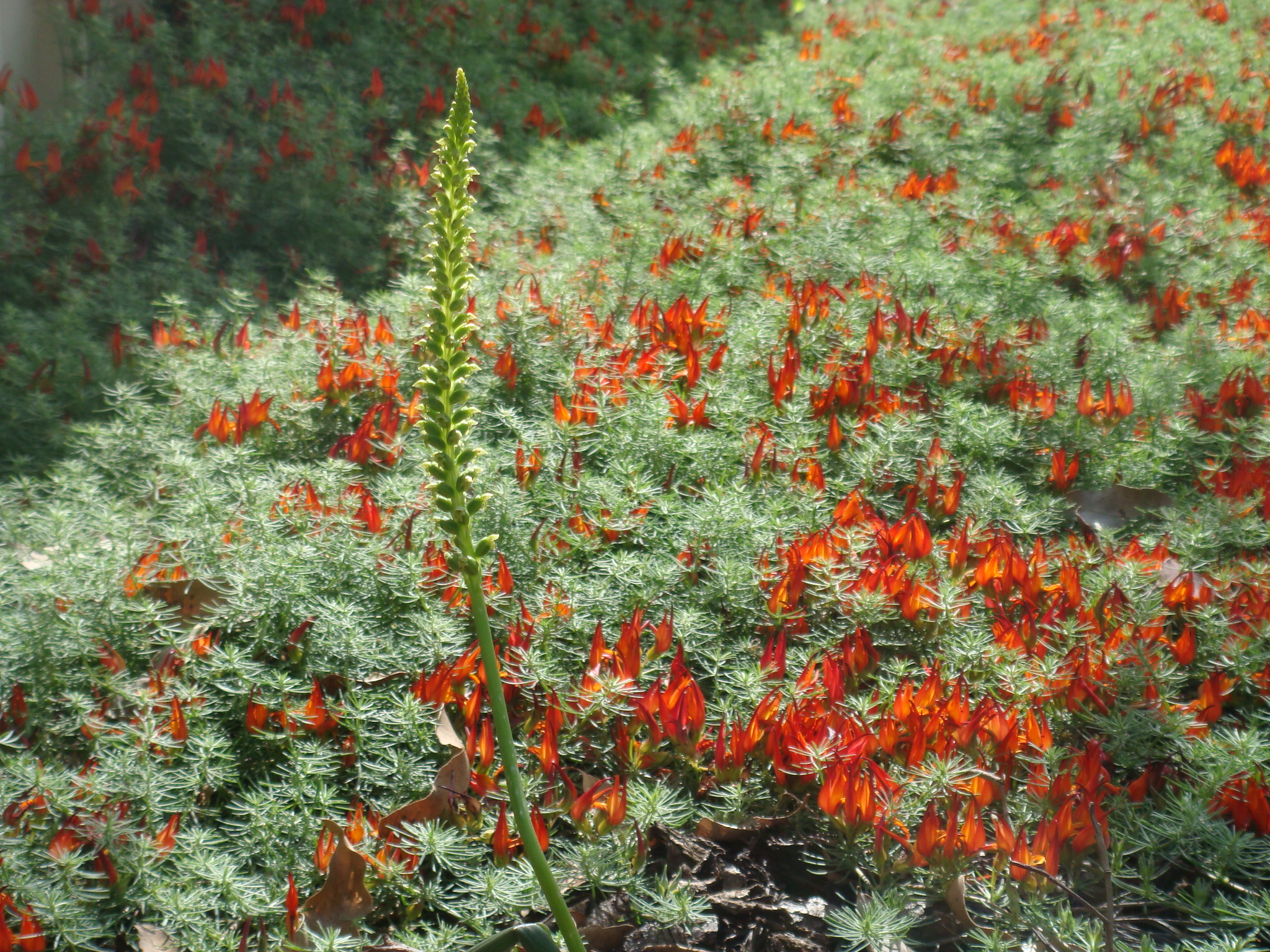
Western Australia’s wild flower ‘White Mignonette’ among the ‘Trailing Lotus’ at Patacara Bhikkhuni Hermitage.

Following is an inspiring poem by Arahat Bhikkhuni Patacara from the Therigatha-Poems of Early Buddhist Nuns.

Ploughing the field with their ploughs,
Sowing seeds upon the ground,
Maintaining their wives and children,
Young men acquire wealth.

Then why, when I am pure in virtue,
Practising the Master’s Teaching,
Have I not attained Nibbana –
For I am not lazy, nor puffed up?

Having washed my feet,
I reflected upon the waters,
When I saw the foot water flow
From the high ground down the slope,
My mind became concentrated
Like an excellent thoroughbred steed.

Having taken a lamp, I entered my cell,
I inspected the bed and sat down on the couch.
Then, having taken a needle,
I pulled down the wick.
The liberation of the mind
Was like the quenching of the lamp.
( Thig. 112-16 )

Bodhi tree and spring flowers outside the sala of Patacara Bhikkhuni Hermitage in September 2012

If  you are reading this post right now, I invite you to close your eyes and spend a few minutes sending good wishes and metta to Ayya Vayama Bhikkhuni for her 60th birthday on 28th October 2012. May she be well, happy, at peace and at ease. May she attain Nibbana in this very life.

Sadhu! Sadhu! Sadhu!

Posted in News, Year 2012 | Leave a comment

Celebrating Ayya Seri’s Ten Year Anniversary

by Ayya Vayama Bhikkhuni

Ayya Seri Bhikkhuni at Patacara Bhikkhuni Hermitage January 2011

Ten years ago, on the 23rd June 2002, Ayya Seri,  then known as Jui Li Poh, a retired pharmacist and naturopath from Leeming, Perth, entered monastic life. With a red streak in her hair and a gold anklet chain, who would have thought that she was a suitable candidate? But here she is today, a Bhikkhuni and a solid member of Patacara Bhikkhuni Hermitage. Not only that, but she cares for Ayya Vayama Bhikkhuni, and is the guardian of her ninety-six year-old grandmother. She specialises in Vinaya, the code of conduct and rules of Bhikkhunis. In fact she has memorised the whole of the Bhikkhuni Vinaya in Pali. Recitation of the Bhikkhuni Vinaya takes about two hours, and is only done in full each fortnight if there are at least four Bhikkhunis present.

Ayya Seri is a true daughter of the Buddha and a blessing to the Sangha!

Sadhu, Sadhu, Sadhu!

Dates of ordination for Ayya Seri Bhikkhuni:
Ordained as an anagarikaa: 14th December 2002
Ordained as a Ten Precept Nun: 4th July 2004
Ordained as a Bhikkhuni: 22nd October 2009

Posted in Announcements, News, Year 2012 | Leave a comment

Vesak Celebration at Patacara Bhikkhuni Hermitage 2012

by Venerable Bhikkhuni Seri

The shrine at Patacara Bhikkhuni Hermitage on Vesak Day

The preparations

We started the final preparations for Vesak a day before the celebration. The work crew was running late due to the heavy rains and the bad traffic. I was getting the hall ready

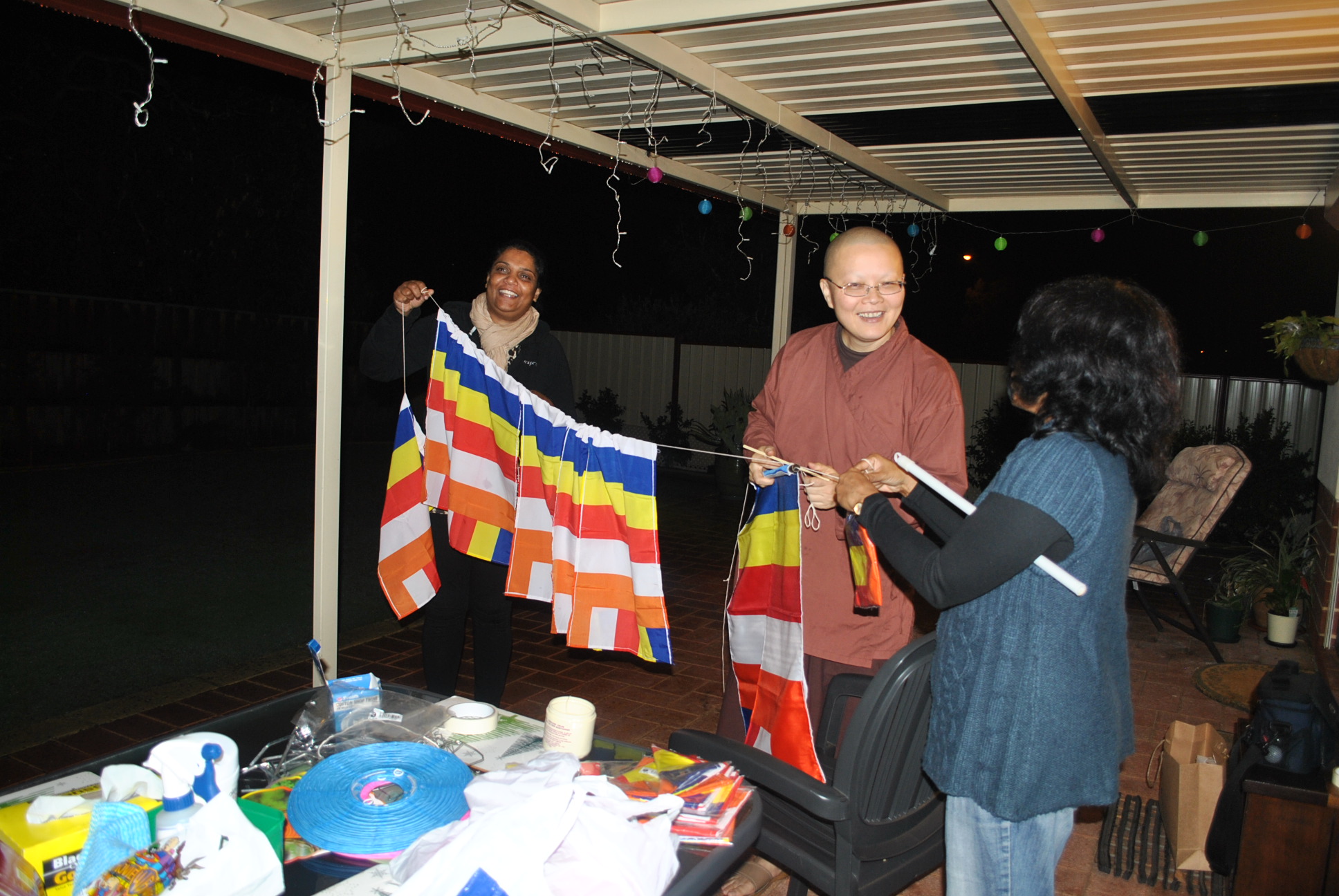
The preparation of Buddhist flags for Vesak Day

for the meditation day tomorrow by myself. Ajahn Vayama helped to dust and clean the Buddha statue and tidied up the book shelf a couple of days before  and Jacky had worked to get the house ready earlier. However, I do feel I am all alone. I was very delighted when the crew arrived safely with enthusiasm despite the severe weather.

The crew steadily and patiently put up the beautiful lights and the traditional Sri Lankan lanterns. We also hung up some Buddhist flags. The magic moment came when we

The work crew hang up the lights for the Vesak celebration.

switched on the beautiful lights. It was like “the path to the deathless” was lit up. It was inspiring to see the lights. Our hearts  swelled because we were the ones who put in the energy and effort with great faith and gratitude to the Lord Buddha. We finished late that night but we went to bed with lots of joy and happiness.

The beautiful lights that lit up the path to libeartion and freedom on Vesak Day.

Vesak Day 

The Buddhist flags, traditional lanterns and lights on Vesak Day.


We celebrated Vesak, the birth, enlightenment and the passing away of the Lord Buddha

The morning chanting: Homage to the Triple Gem on Vesak Day.

on Saturday, 5th May 2012. Sixteen people participated in the celebration. We spent the day meditating and contemplating the Dhamma. As the Buddha said to Venerable Ananda in the Mahaparinibbana Sutta in the Digha Nikaya:
“…And yet,  Ananda, whatever monk, nun, male or female lay-follower dwells practising the Dhamma properly, and perfectly fulfils the Dhamma-way, he or she honours the Tathagata, reveres and esteems him and pays him the supreme homage. Therefore, Ananda, ” We will dwell practising the Dhamma properly and perfectly fulfil the Dhamma-way”— this must be your watchword.’….”

“…’Lord, what shall we do with the Tathagata’s remains?’ ‘Do not worry yourselves about the funeral arrangements, Ananda. You should strive for the highest goal, devote yourselves to the highest goal, and dwell with your minds tirelessly, zealously devoted to the highest goal…..”
( Translated by Maurice Walshe )

A day of meditation and reflections to honor the birth, enlightenment and the passing away of the Buddha.

All of us spent the day watering the Bodhi tree in our heart, following and honouring the instructions of the Lord Buddha.

Ajahn Vayama and Venerable Seri on Vesak Meditation Day.

This year the theme of the day’s practice and reflection was Metta, lovingkindness. We looked at various suttas in which the Buddha taught about Metta, the practice and the blessings of Metta. I love the sutta from the Itivuttaka, 27 :The Development of Loving-kindness:
“This was said by the Lord…..
‘Bhikkhus, whatever grounds there are for making merits productive of a future birth, all these do not equal a sixteenth part of the mind-release of loving-kindness. The mind-release of loving-kindness surpasses them and shines forth, bright and brilliant.
‘ Just as the radiance of all the stars does not equal a sixteenth part of the moon’s radiance, but the moon’s radiance surpasses them and shines forth, bright and brilliant, even so, whatever grounds there are for making merit productive of future birth, all these do not equal a sixteenth part of the mind-release of loving-kindness……’
‘Just as in the last month of the rainy season, in the autumn, when the sky is clear and free of clouds, the sun, on ascending, dispels the darkness of space and shines forth, bright and brilliant, even so, whatever grounds there are for making merit productive of a future birth, all these do not equal a sixteenth part of the mind-release of loving-kindness…..’
( translated by John D. Ireland )

Patacara Bhikkhuni Hermitage on Vesak Day.

Throughout the day,we especially focused on various practices and ways that we can make loving-kindness, metta, our constant dwelling place. We looked closely at the sutta,” The blessings of Lovingkindness” in the Anguttara Nikaya:
“If, O monks, the liberation of the mind by loving-kindness is developed and cultivated, frequently practised, made one’s vehicle and foundation, firmly established , consolidated, and properly undertaken, eleven blessings may be expected…..”
( Translated and edited by Nyanaponika Thera and Bhikkhu Bodhi )

We finished a day of practice with an inspiring reminder from the Udana 8.3, by the Lord Buddha: “For one who clings, motion exists; but for one who clings not, there is no motion. Where no motion is, there is stillness. Where stillness is, there is no craving. Where no craving is, there is neither coming nor going. Where no coming nor going is, there is neither arising nor passing away. Where neither arising nor passing away is, there is neither this world nor a world beyond, nor a state between. This, verily, is the end of suffering.”
( Found in ‘The Four Sublime States’ by Nyanaponika Thera )

Ajahn Vayama and Venerable Seri at Patacara Bhikkhuni Hermitage on Vesak Day.

On this Vesak Day, Ajahn Vayama did not offer any reflections. But she stayed throughout the day meditating with us. Ajahn Vayama’s presence inspired all of us. Even though her body is sick and disabled, she still continues to practice and find peace and refuge in the Buddha and the Dhamma.

At Patacara Bhikkhuni Hermitage on Vesak Day.

We must acknowledge a few special offerings for this Vesak celebration. Michelle offered her time and energy to make a special stand for the Lord Buddha to sit on, in memory of her father Roland Richardson, in time for the Vesak celebration. Peggy offered the material for the stand in memory of her good friend Millie Yeap Ee Moy. We also appreciate the kindness of some Sri Lankan supporters, Dhyan and Lali Caldera, who sent some traditional lanterns from Sri Lanka for Vesak, and Kamaj Wanigasuriya who offfered the Buddhist flags. Sadhu! Sadhu! Sadhu!

Ajahn Vayama, Venerable Seri and the devotees on Vesak Day.

May all beings be well , happy and at peace.
Happy Vesak to all of you!

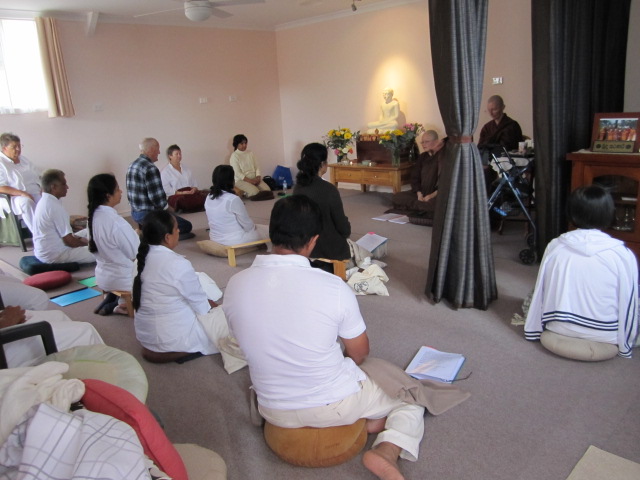
At the end of a day of practice inside the sala of Patacara Bhikkhuni Hermitage on Vesak Day.

Posted in News, Year 2012 | Leave a comment

Pilgrimage to Sri Lanka 2012 – The People

Reflections by Venerable Bhikkhuni Seri

The sangha at Sri Maha Bodhi

Ajahn Vayama and myself went on a pilgrimage to Sri Lanka from 25th January to 7th February. I was touched and inspired by Sri Lanka, all the beautiful and auspicious sacred sites and especially the people, the people that we travelled with and the people that we met in Sri Lanka.

There were 11 of us in the pilgrimage group: Ajahn Vayama, Ajahn Apichato, Ajahn Nissarano who joined us in Sri Lanka, Venerable Jhanaratto and myself, Phalinee, our group leader from Perth, Trevor and Merry from Perth and Phalinee’s family, some of them from Thailand. Our tour guide and drivers were Buddhists in Sri Lanka.

Our pilgrimage group at Gal Vihara

The removalists at the Ganga Arama Temple in Colombo

I was touched by the kindness and generosity of our tour leader Phalinee. Out of faith to the Triple Gem and her gratitude and love to Ajahn Vayama, Phalinee especially organised the pilgrimage for Ajahn. Because of Phalinee’s determination and effort, there was nothing impossible and that can’t be done for Phalinee during the pilgrimage. Her kindness and generosity inspired others to join in to make merits and to help . She managed  to get Ajahn Vayama, who is disabled and sick in a wheel chair, to go to most of the sacred sites such as Sri Maha Bodhi in Anuradhapura, Temple of the Tooth Relic in Kandy, Gal Vihara and various temples. Phalinee and myself as well as the rest of  the group needed to help Ajahn Vayama up and down from the bus and even in and out at most of the disabled unfriendly hotels. It is amazing everything went smoothly and well.

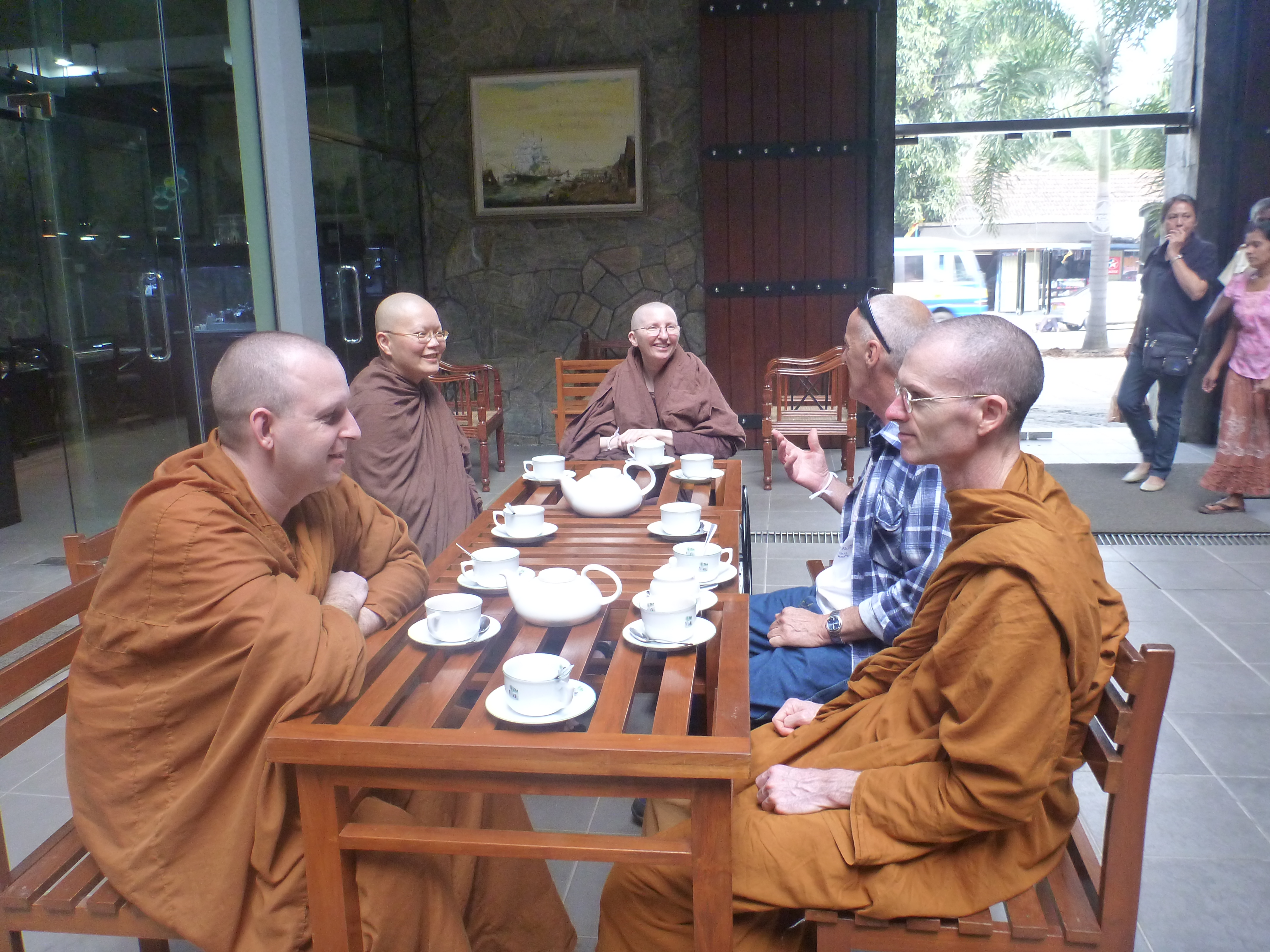
Having a cuppa at tea outlet just out of Kandy

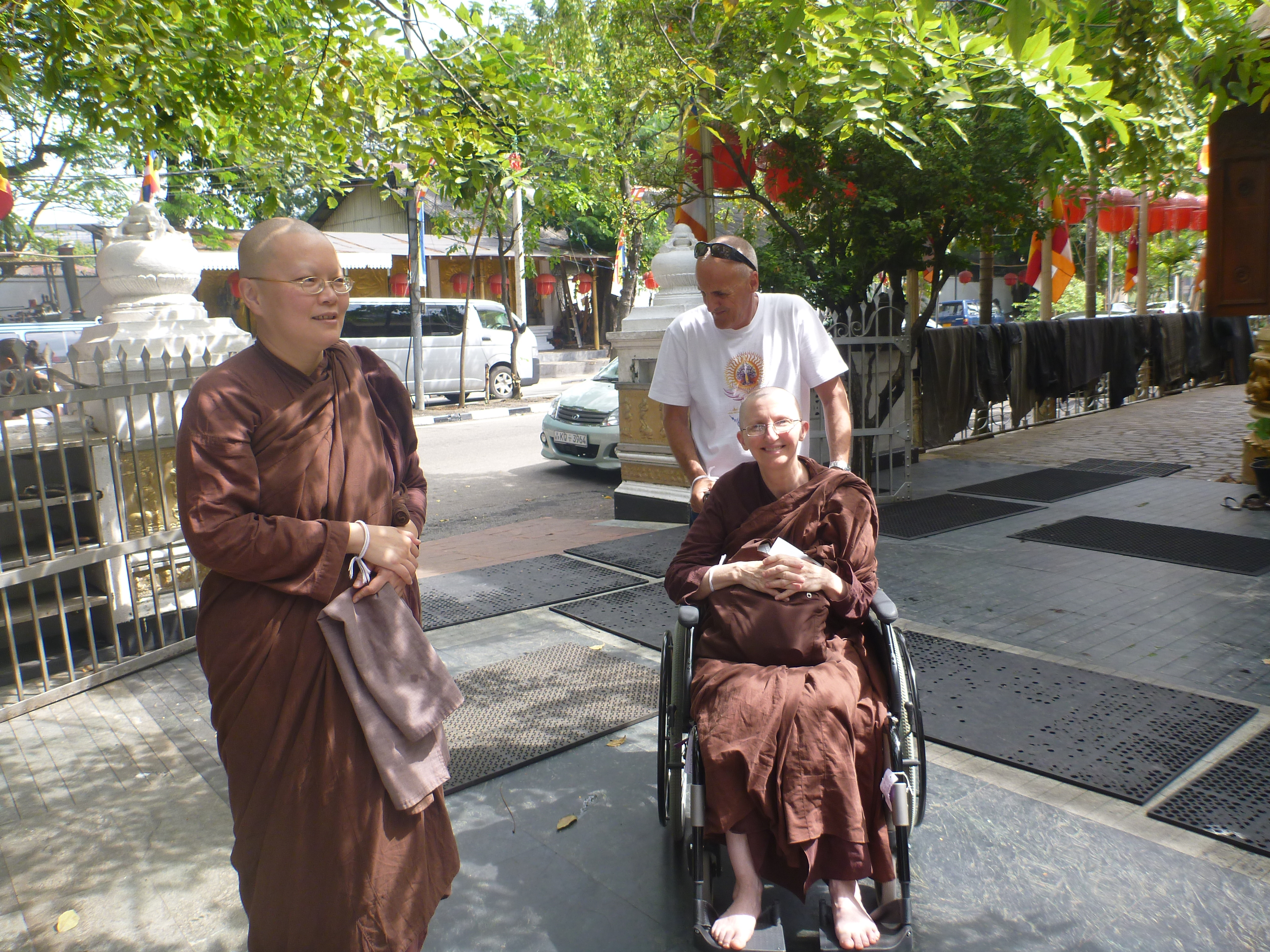
Everyone on the pilgrimage was very kind ,compassionate, patience, practising all the qualities of a spiritual warrior. There was no anger or agitation because we had to wait or go slowly  due to Ajahn Vayama’s disability. Everybody waited with a smile on their face with a readiness to help when we were going up and down into the tour bus. Trevor was Ajahn Vayama’s volunteer chauffeur, pushing her and her wheel chair all over Sri Lanka, from the hotels to the sacred sites. Out of his gratitude to Ajahn Vayama, Trevor made this beautiful determination to be Ajahn’s chauffeur. I asked him one afternoon when he was sending us together with Merry to our room that he must be feeling the pain in his shoulder and  back. He turned around and smiled and said he could not understand it but the wheel chair seemed very light in his hand!

Ajahn Vayama, Venerable Seri and Trevor, Ajahn's chauffeur entering Ganga Arama Temple

The pilgrimage was very special to me. This was my first visit to Sri Lanka. But I felt deeply connected to a country that mainly speaks Sinhala, a language that I could not understand. This is because of my teacher Ajahn Vayama. Throughout the pilgrimage, Ajahn was telling me and us about the coconuts, the villages, the people and the places that she had been. I also felt connected to the faith and confidence of the people in the Buddha, Dhamma and Sangha.

Ajahn Vayama told us that she met Venerable Nynaponika at Uda Watte Kele,  in Kandy, the first monastic she ever encountered during her first trip as a tourist to Sri Lanka in 1977. He advised her to read more Dhamma books and she did!

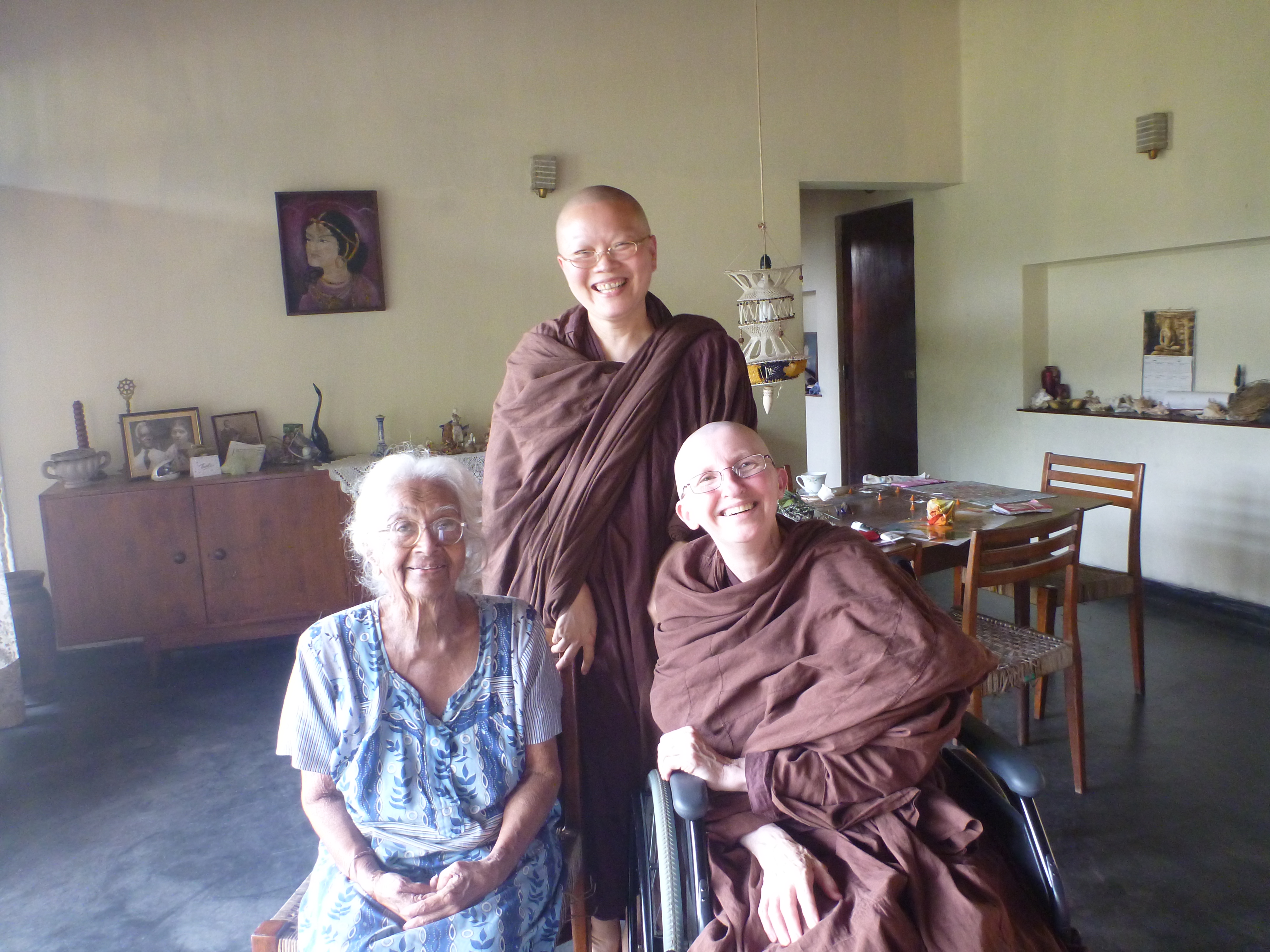
Ajahn Vayama, Venerable Seri and Chandra in Kandy

We also got the opportunity to meet up with Ajahn Vayama’s supporters in Sri Lanka. Those supporters who helped her all the way back since she ordained in 1985. We met Chandra who was Ajahn’s  “mother” in Sri Lanka. Even though Ajahn Vayama had not been back to visit her for more than seven years  Ajahn could give instruction to the driver to take us to Chandra’s place in Kandy! Merry and myself were at awe with Ajahn Vayama who reminded Chandra of all the kindness and generosity that Chandra had offered to Ajahn while she was in Sri Lanka.

I was very touched by the supporters who made so much effort to come to see Ajahn. I saw the love and respect in their eyes.They have so much gratitude and appreciation for their podi mani( Ajahn Vayama ) who became a loku mani. Their loku mani, Ajahn Vayama even brought a podi mani ( Venerable Seri ) that she trained in Australia to Sri Lanka. Ajahn Vayama loves the life in the village. She said she loves the simplicity, straight forwardness, and devotion of people . They accepted Ajahn Vayama as she was. Lumbini said that Ajahn left Sri Lanka to return to Australia, because she would like to share  what she learned with the people in Australia. Because of Ajahn Vayama ‘s return to Australia, there is a training monastery and ordination for Ten Precept nuns, and finally the first Bhikkhuni Ordination in Australia in 2009 led by Ajahn Vayama. When Phalinee thanked the supporters  for coming, they  turned around and said:” We do not only love her, we adore Ajahn Vayama. We used to think that she is saintly, now she is more saintly than before, and she looks so pure and has not changed much!”

Ajahn Vayama, Venerable Seri, Dayasili ( on the right) and family

Dayasili, a helper to the nuns dating back to Parappaduwa Nuns Island, came with her family. It took them three hours to travel in a three-wheeler to Colombo to see Ajahn Vayama. She only speaks Sinhalese and Ajahn Vayama could understand but could not speak much Sinhalese. I was amazed at how they could ever communicate with each other. Ajahn Vayama said they understood each other. And it was great to watch and be there to witness that!  Dayasili brought some sweets that they made in the village .When the time came to part, Dayasili’s eyes were filled with tears when she paid respect to Ajahn Vayama. She walked away without looking back. My eyes swelled.

We also had the opportunity to met  Ajahn Dhiravamso and Ajahn Guttasila at the Buddhist Publication Society in Kandy. I was inspired to see the venerables including Ajahn Nissarano, contented and happy practising in solitude and in a basic and simple environment, going on pindapat ( alms ) in the villages for their daily dana. It demonstrated to me that it is still possible in this day and age to live a simple contemplative life as a monastic.

Chanting of the Ratana Sutta in front of the Buddha Statue

We went on pilgrimage to the sacred sites of Sri Lanka. Without the warmth, devotion and sincerity of the people to practise the Dhamma, a sacred site would only be an empty and cold shell. I was delighted to find the Dhamma still alive in Sri Lanka.

Venerable Seri and Merry at Grand Palace, Bangkok. All the photos supplied by Merry

Posted in News, Year 2012 | Tagged | Leave a comment

Pilgrimage to Sri Lanka 2012 – The Places

Reflections by Venerable Bhikkhuni Seri

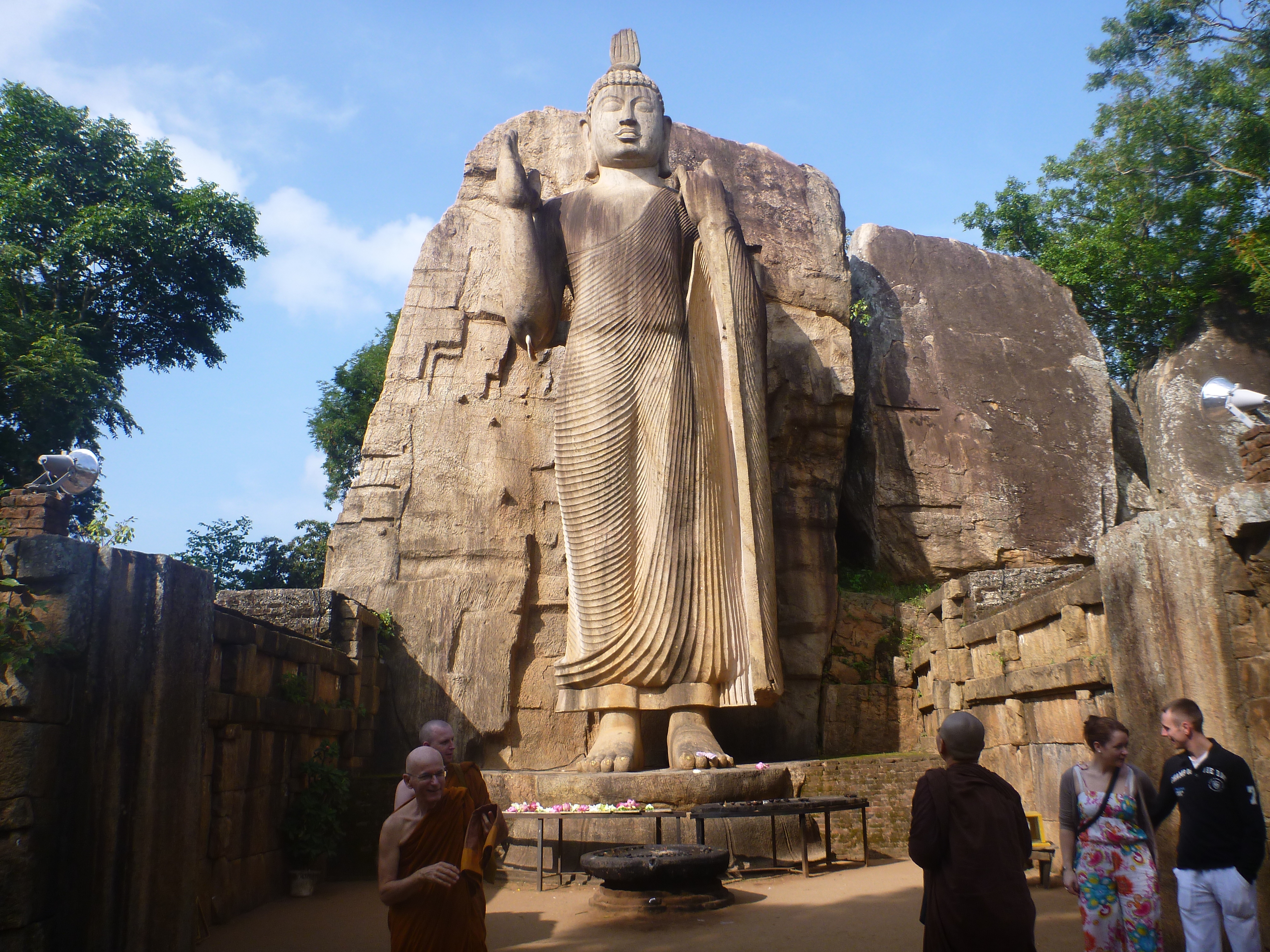
Aukana Buddha near Anuradhapura

 I am sharing with you through the prism of a bhikkhuni who visited Sri Lanka for the first time. We visited the major sacred sites and monasteries: Sri Maha Bodhi, The Great Stupa-Ruwanweliseya and the Jetavana Stupa, and Aukana Buddha statue in Anuradhapura, Gal Vihara and Polonnaruwa, Dambulla Rock Temple in Dambulla, Temple of Tooth Relic ( Sri Dalada Maligava ) in Kandy, Malwatta Raja Maha Vihara in Kandy, Kelaniya Temple  in Kelaniya and Ganga Arama in Colombo.

The pilgrimage group at Sri Maha Bodhi Anuradhapura

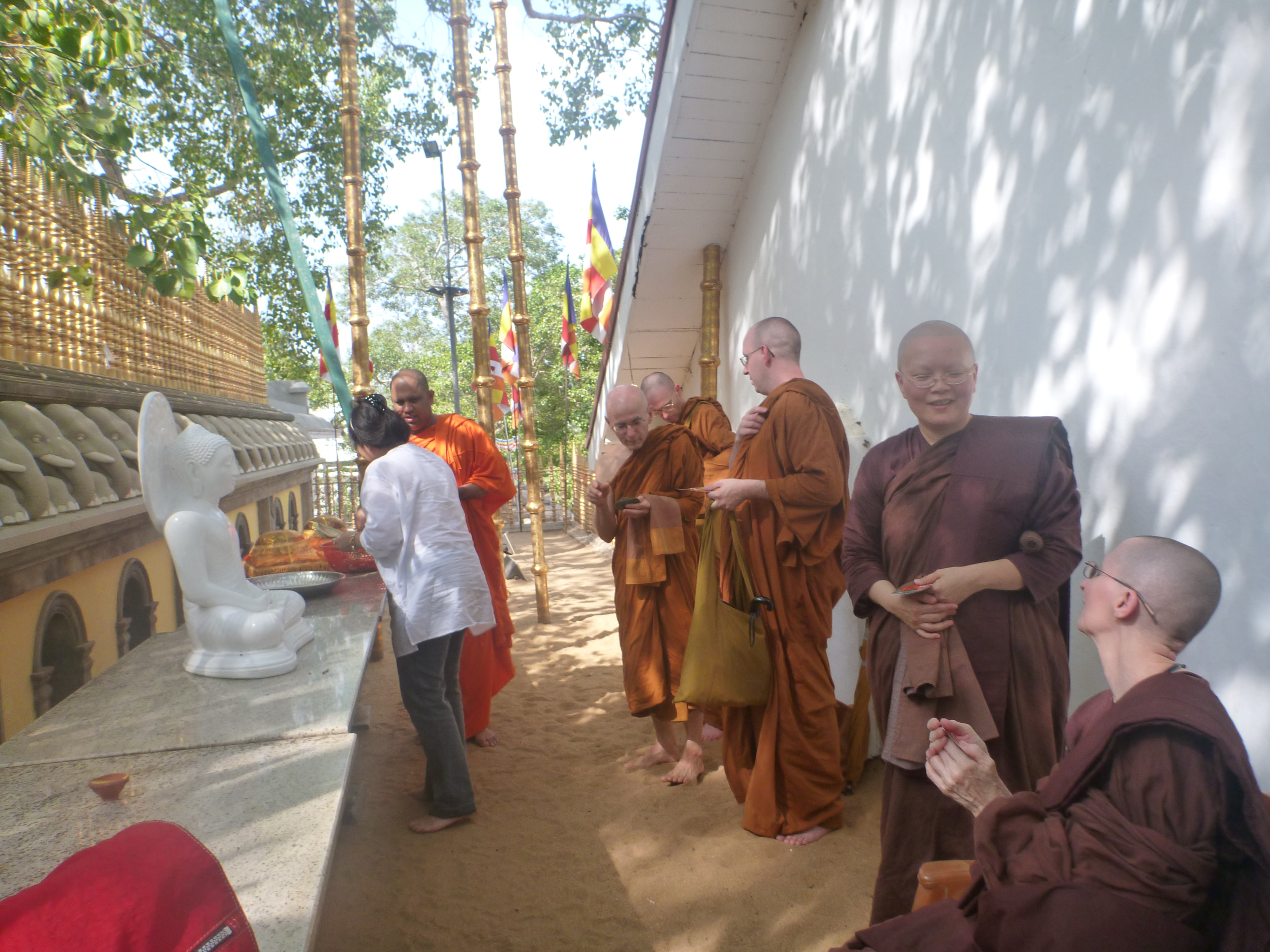
We went to Sri Maha Bodhi to pay respect and revere the Bodhi Tree which was grown from a cutting of the Bodhi Tree where the Buddha sat and attained Nibbana . I was moved by the people from the pilgrimage group and the people around. They carried Ajahn Vayama in her chair up the stairs to the terrace around the Bodhi tree. They made it possible for Ajahn to join in the puja and offerings. I had been trying hard to learn the verses to venerate the Bodhi Tree. It brought tears into my eyes when we had the opportunity to chant the verses:

The Sacred Bodhi Tree at Sri Maha Bodhi, Anuradhapura

Yassa Mule nisinova
Sabbari Vijayam aka
Patto sabbannu-tam sattha
Vande tam Bodhi padapam
Ime ete maha Bodhi
Loka nathena pujita
Ahampi te namassami
Bodhi Raja namatthu te.

The other significance of the Bodhi Tree for me as a Bhikkhuni is that the cutting of the Bodhi Tree was brought by Arahat Bhikkhuni Sanghamitta from India to Sri Lanka. Arahat Bhikkhuni Sanghamitta also brought the ordination of Bhikkhunis to Sri Lanka. I felt the connection to that event, as Ajahn Vayama was ordained in Sri Lanka in 1985. I got the opportunity to train and ordain as a Ten precept nun in Australia in 2004 with Ajahn Vayama. Later, in 2009, I ordained as a Bhikkhuni.

Ruwanvalisaya - the Great Stupa at Anuradhapura

Venerable Seri paying respect to the Great Stupa

This pilgrimage is very special  for me as I had the opportunity to go on pilgrimage to Sri Lanka with Ajahn Vayama who ordained and spent ten years there. Ajahn Vayama pointed out the places that she had sat and meditated during her last  pilgrimage in Sri Lanka in 1995 with her supporters Nanda and Chandra, especially Gal Vihara and Ruwanvalisaya . Nanda told me when they went to meditate at Ruwanvalisaya Stupa in Anuradhapura early in the morning . Two groups of pilgrims came and made a comment that a new statue was erected here when they saw Ajahn Vayama meditating  there!

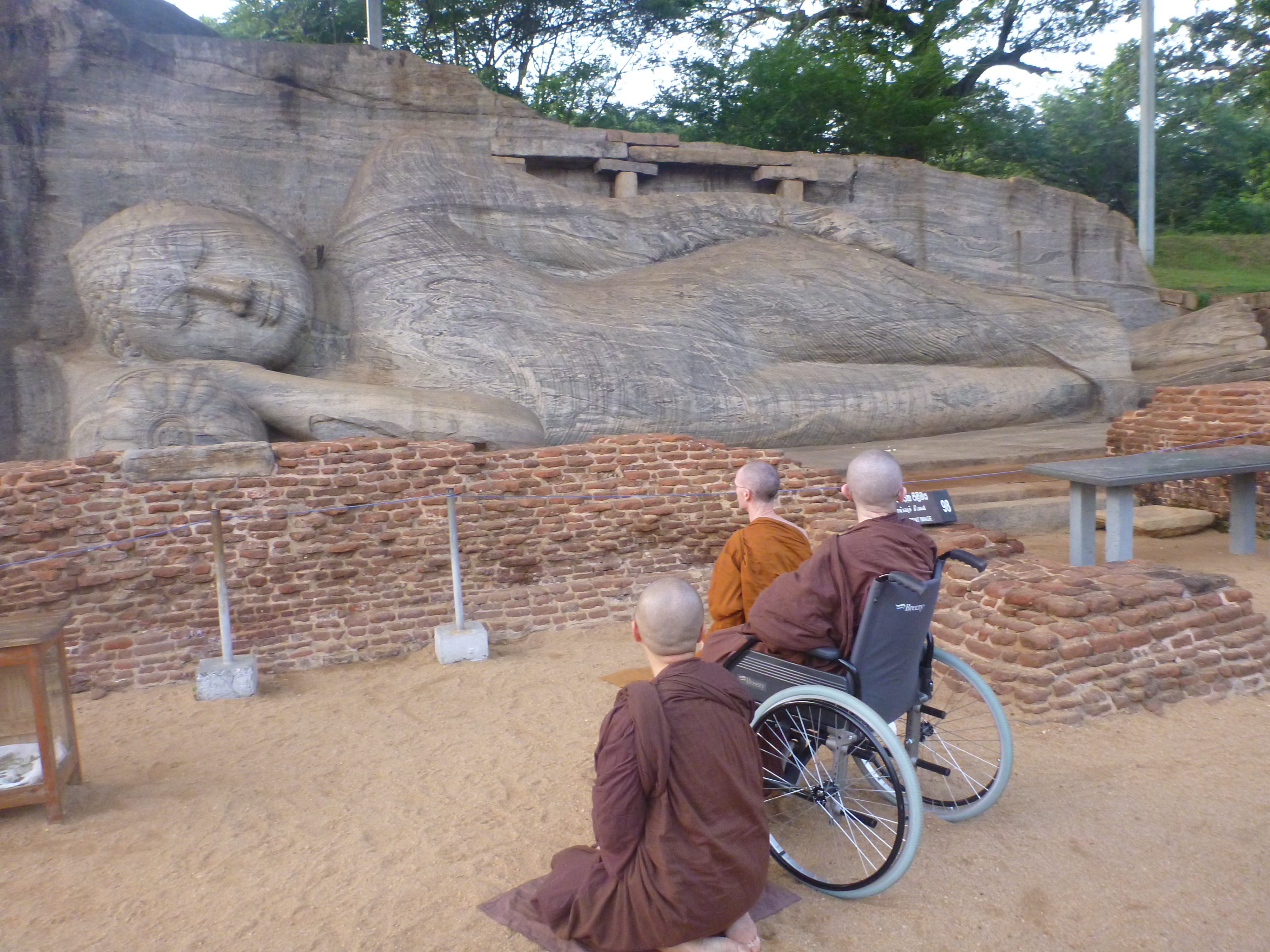
Reclining Buddha at Gal Vihara

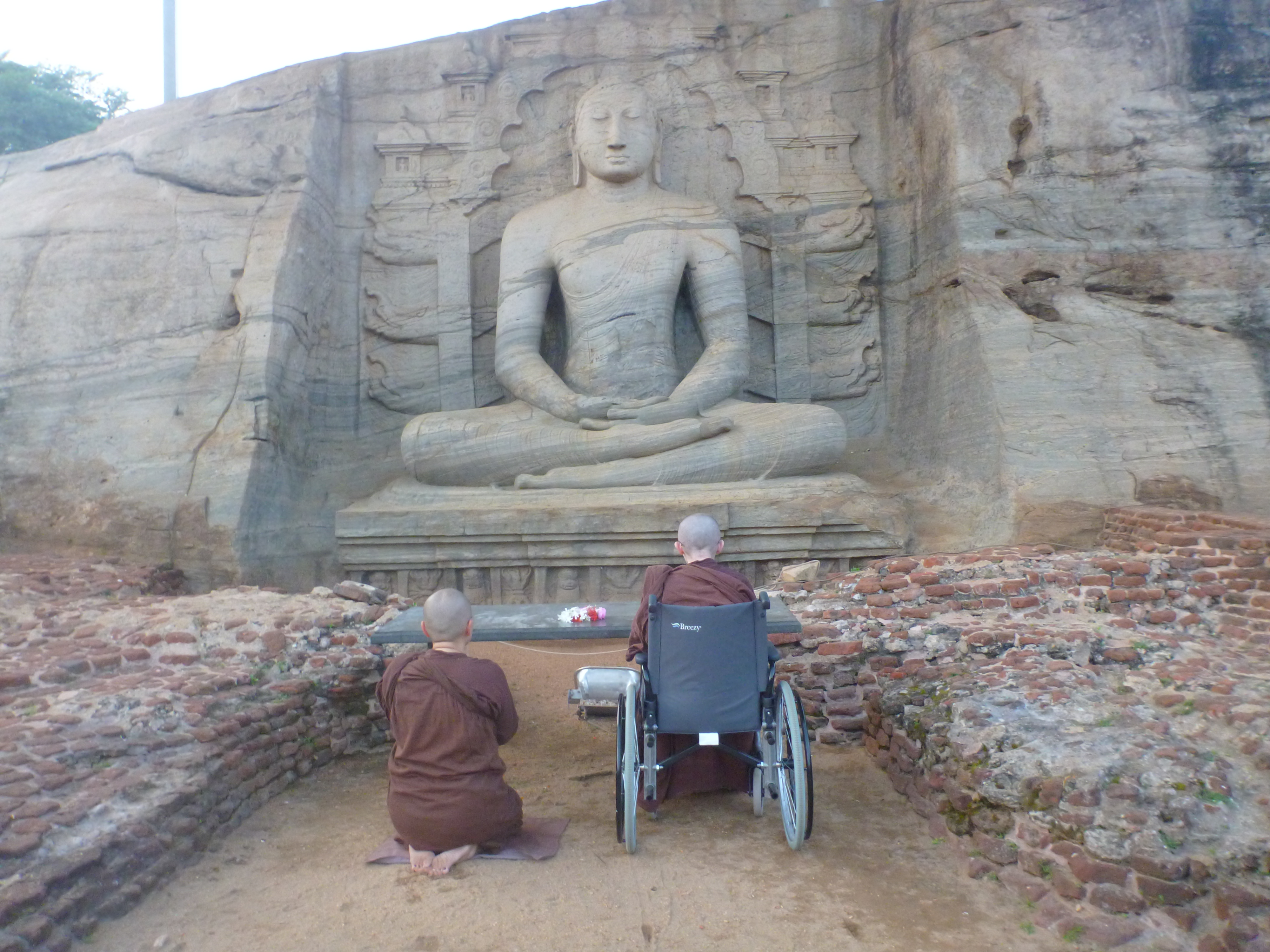
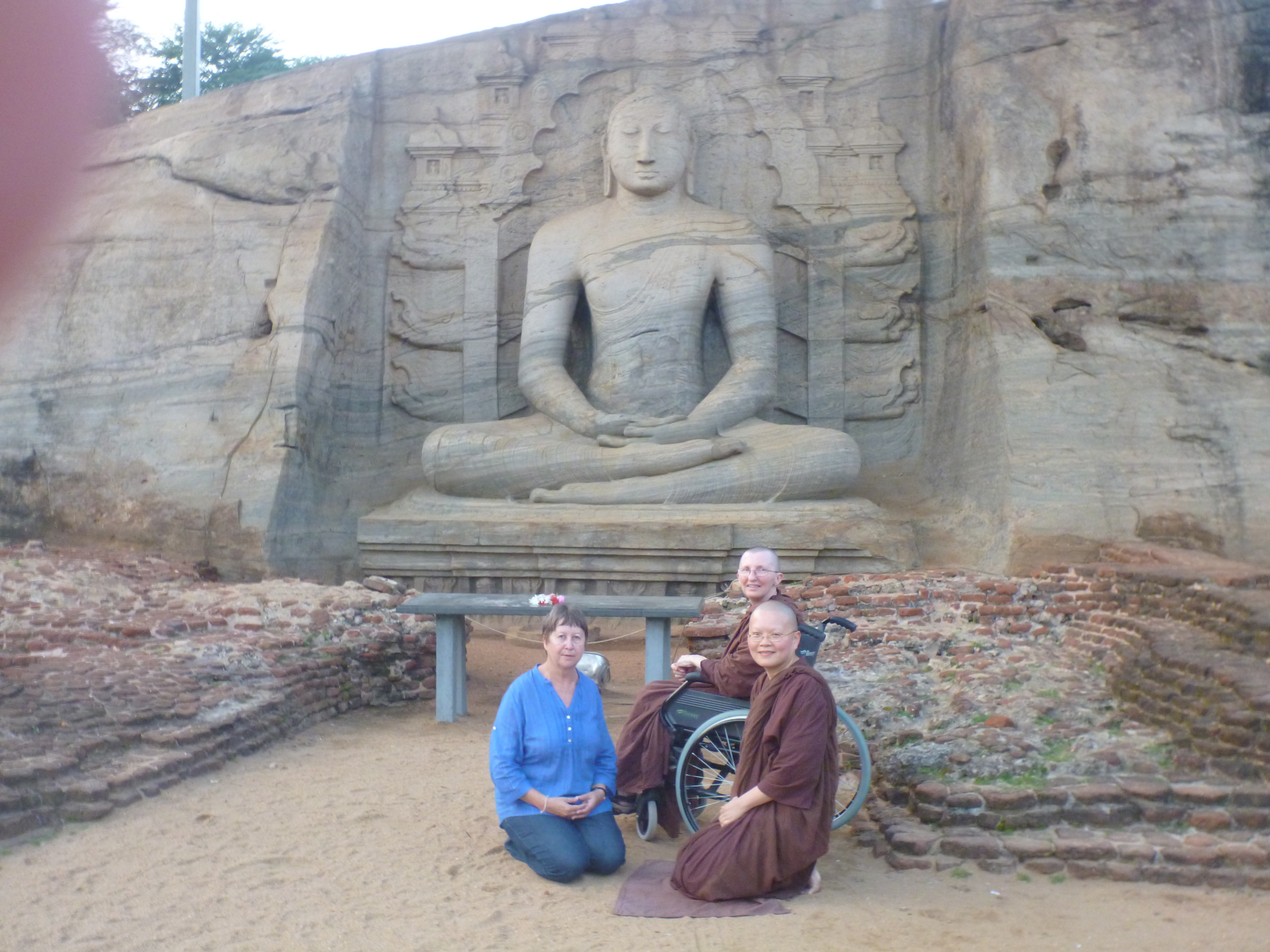
Ajahn Vayama’s favourite place is Gal Vihara. It has four Buddha statues in seated meditation, standing and Mahaparinibana postures that were carved out of one granite rock. They each have a beautifully serene and peaceful face. I also loved the space and surrounding of Gal Vihara. There is a feeling of peace and openness. We chanted  offerings to the Buddha, Dhamma and Sangha as well as the Ratana Sutta.

Meditative Buddha at Gal Vihara

The Buddha Image in seated meditation position at Gal Vihara

At Gal Vihara, a man practising in the Vajayana tradition offered some money to Ajahn Vayama spontaneously. We told him  we do not accept money. After he found out we are from the Theravada Tradition, he made a comment about Theravada practises for one self ,and he practises for all beings. I smiled and walked away.

The Standing and Reclining Buddha Images at Gal Vihara

 I was reflecting upon his comment afterwards. Here we were, a group of pilgrims of four fold assembly, Bhikkhus, Bhikkhunis, layman and laywomen from different cultural backgrounds. We travelled in harmony, with great faith, generosity, kindness, compassion and patience, all the beautiful qualities that are mentioned in the teaching of the Buddha. We met many groups from Europe, China, Japan, Korea, US and the locals. I noticed the benovalent looks on their faces when they saw us helping Ajahn Vayama in her wheel chair to various places. Because  of our action, especially towards a disabled sangha member, all the beings seen and unseen that we met, rejoiced and were inspired to join in to help and share in the merits.  To me, our pilgrimage not just nourished our own heart but also  touched and benefitted all beings.

The Bodhi Tree at Dambulla Rock Temple

Dambulla Rock Temple left a strong impression on me because we spent some time meditating under the Bodhi Tree on top of the hill. I was also fond of Kandalama. The place that we stayed in was surrounded by forest, hills, water, monkeys, and more monkeys as well as other animals. We had the opportunity to share and to discuss the Dhamma together as a group on two separate afternoons. I also loved o be able to spend time doing walking meditation in the large open area outside our room surrounded by trees and monkeys.

View from Kandalama with Sigiriya in the distance

We arrived at Kelaniya Temple in Kelaniya on Sri Lanka’s Independence Day. The temple was packed with lay devotees in whites ( upasikas and upasakas ).  It was a hot, busy and chaotic day with people everywhere. But I was surrounded and uplifted by a sea of devotion and faith. It was amazing when Phalinee and the tour guide managed to get the white sea parted for us to wheel Ajahn Vayama through.

Looking at the Wall Paintings inside Kelaniya Temple

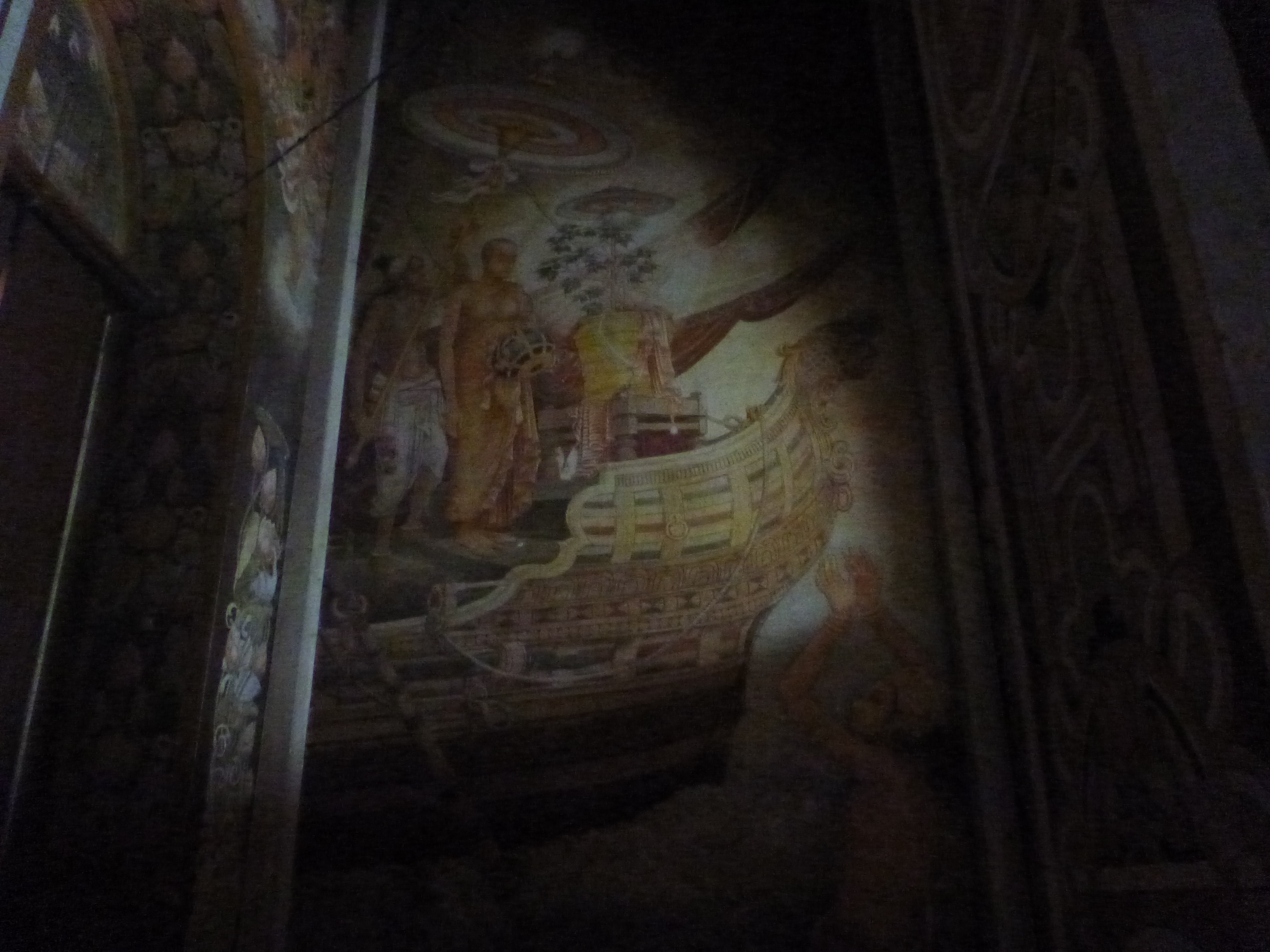
Ajahn Vayama was telling me about the famous wall painting of Arahat bhikkhuni Sanghamitta arriving with a sapling of Bodhi tree. She made sure I had the opportunity to see the painting. When I bowed down to the painting of Arahat Bhikkhuni Sanghamitta, I was moved to tears. I am very grateful to have the opportunity to follow the foot steps of the Venerable Bhikkhuni.

Wall Painting of Arahat Bhikkhuni Sanghamitta arriving with a sapling of Bodhi Tree from India at Kelaniya Temple

I had a very good impression of Sri Lanka. I left Sri Lanka feeling inspired and with a heart nourished with faith,devotion, kindness and compassion.

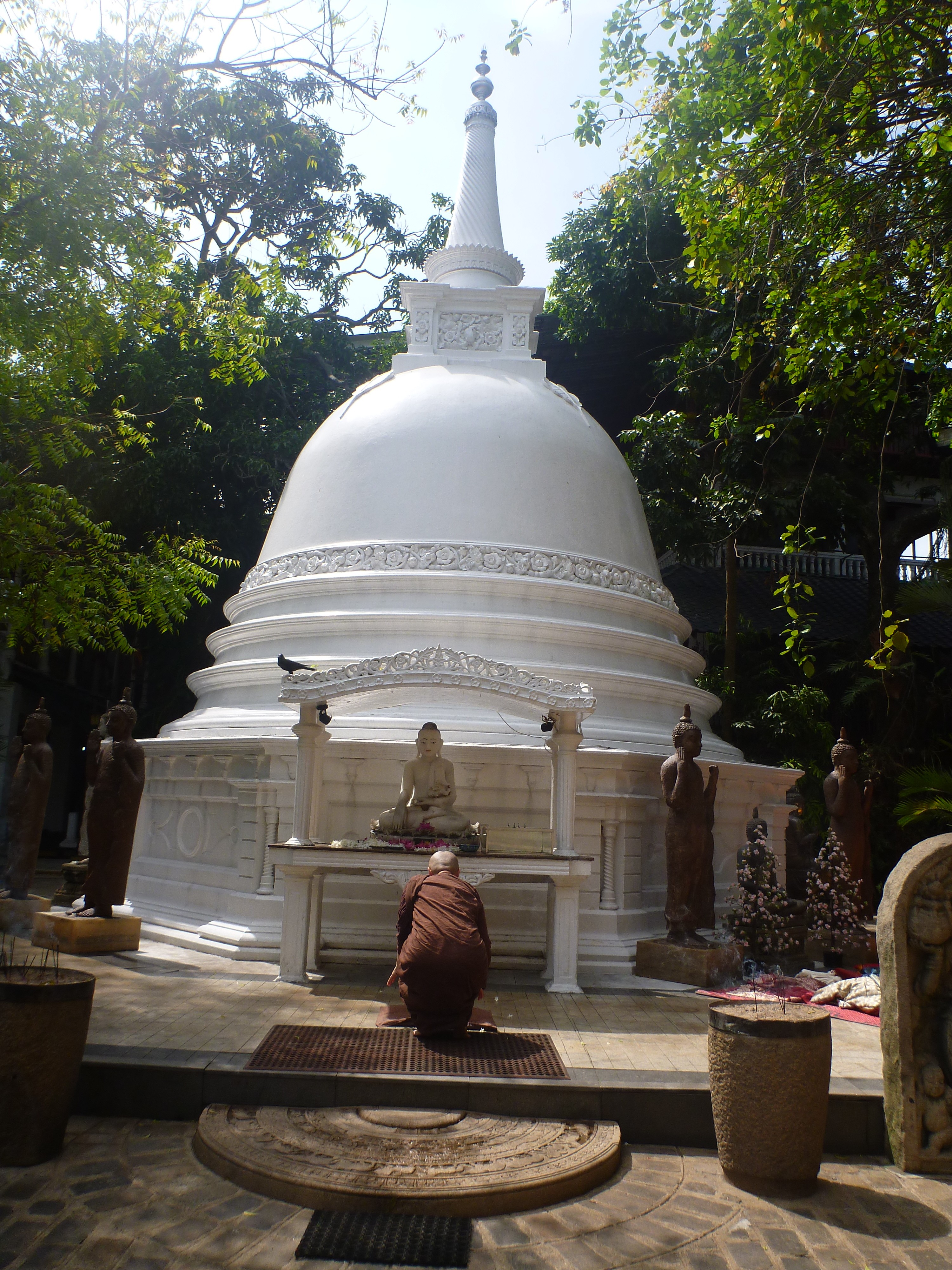
Stupa at Ganga Arama Temple in Colombo

Ajahn Vayama and myself  especially would like to dedicate the merits of this pilgrimage to Sri Lanka to Millie Wong, a good friend who passed away on 14th February 2012. May she be at peace and may she have a favourable rebirth where she can continue to practise for the attainment of Nibbana!
 

Posted in News, Year 2012 | Tagged | Leave a comment